Duncan Browne
Band members Related acts
|
line up 1 (1968) - Duncan Browne (RIP 1993) -- vocals, guitar
supporting musicians (1968) - David Bretton -- backing vocals - Nicky Hopkins --= harpsichord, keyboards
line up 2 (1979) - Duncan Browne (RIP 1993) -- vocals
supporting musicians (1979) - Dick Morrissey -- sax - Tony Hymas -- keyboards - John Giblin -- bass - Simon Phillips -- drums, percussion
|
- Brand X (John Giblin) - Lorel (Duncan Browne) - Metro (Duncan Browne) - Nuevo (John Giblin) - Public Zone (John Giblin) - Simple Minds (John Giblin)
|
|
Genre: Baroque-pop Rating: 4 stars **** Title: Give Me Take Me Company: Immediate Catalog:
Z12 52012 Country/State: London, UK Grade (cover/record): VG+/VG+ Comments: US pressing, original inner sleeve Available: 1 Catalog ID: 3177 Price: $160.00
|
In high school and college the late Duncan Browne played clarinet and studied music theory. He didn't consider a musical career until he saw Bob Dylan's appearance in the January 1963 BBC’s Sunday Night Play drama The Madhouse on Castle Street. Coinciding with his first tour of the UK, Dylan was picked to star in the play, but had issues remembering the dialog so director Philip Saville revamped the play, casting Dylan as a supporting character who was allowed to "sing" his dialog.
Like thousands of other young people, Browne subsequently went out and bought an acoustic guitar, teaching himself how to play. Like a sizable part of his generation, Browne started busking on London streets and after borrowing thirty pounds from his father, hit the road to see Europe After the trip he enrolled in London Academy of Music and Dramatic Art. He majored in drama, but continued to play guitar and study music theory. His initial brush with musical success came in 1967. Under the name "Lorel" Browne and singer/songwriter Davy Morgan attracted the attention of Andrew Long Oldham who signed the pair to his Immediate Records label. Teamed with The Manfreds' singer Mike d'Abo in the producer role, they recorded several demos including the songs "Here and Now", "The Men From Somewhere Else" and an original composition entitled "A Whiter Shade of Pale" that like the Procol Harum song, was based on a Johan Sebastian Bach inspired melody. The first two songs were originally envisioned as the pair's debut single, but Oldham rejected the folk-flavored tracks. Morgan subsequently walked away from the Lorel. Browne stayed on the Immediate payroll as an arranger; Oldham taking notice and offering him a chance to record an album with college friend David Bretton serving as lyricist.
Produced
by Oldham, 1968's "Give Me Take Me" is one of those
albums that gets rave reviews and is widely labeled a classic release.
I was certainly curious to find a copy and he
"Give Me
Take Me" track listing: 1.) Give Me Take You (Duncan Browne - Geoff Bretton) - 3:23 rating: **** stars If you ever need an example of "baroque folk" you might want to grab "Give Me Take You". Opening up with some angelic choir vocals and featuring harp and Browne's finger picking acoustic guitar, the first couple of times I listened to the song I thought it was hyper-sensitive; fey and simply pretentious. Yeah, it sounded a bit like a Nick Drake effort. And then I slowly started to recognize what a great tune it really was. The melody and vocals are mesmerizing, serving as one of those tunes that can instantly reduce your blood pressure. For comparison purposes it also reminds me of Colin Blunstone and The Zombies, or somewhat more contemporary, something The Alan Parsons Projects might have recorded during their prime. 2.) Ninepence Worth of Walking (Duncan Browne - Geoff Bretton) - 3:27 rating: **** stars The lyrics to "Ninepence Worth of Walking" were supposedly inspired by the bus-fare he paid to get to a girlfriend's residence. When the relationship ended Browne walked the distance. Musically the song was a stark folk tune featuring Browne's warm and reflective voice accompanied by acoustic guitar, acoustic bass and light percussion. The shimmering vocal arrangement and hand claps saved it from "also ran" status. 3.)
Dwarf in a Tree (A Cautionary Tale) (Duncan Browne - Geoff Bretton)
-3:11 rating: ***
stars 4.) The Ghost Walks (Duncan Browne - Geoff Bretton) - 5:55 rating: **** stars To my ears, "The Ghost Walks" was a straight-ahead folk tune. Yeah, it was wordy and sounded autobiographical (life as a musical has-been), but with a lovely, pastoral melody, melodic acoustic guitars and oboe, it wouldn't have sounded out of place on a Fairport Convention album. 5.) Waking You (Part One) (Duncan Browne - Geoff Bretton) -1:09 rating: **** stars Another tune with a medieval vibe, the brief "Waking You (Part One)" was interesting for Browne's multi-tracked vocals. One of the album's prettiest performances. 6.) Chloe in the Garden (Duncan Browne - Geoff Bretton) - 5:07 rating: **** stars Well the title and opening "wind" sound effects certainly gave me pause ... That said, "Chloe in the Garden" was a gorgeous and fragile orchestrated acoustic ballad that reminded me of a mash-up of Donovan and Drake. 7.) Waking You (Part Two) (Duncan Browne - Geoff Bretton) - 0:57 rating: *** stars Not sure what the logic was for dividing "Waking You" into two segments. Pretty, but clocking in at under a moment I kind of missed the point.
(side 2) 1.) On the Bombsite (Duncan Browne - Geoff Bretton) - 3:10 rating: **** stars I can't help but smile at the thought Immediate saw fit to release a single off the album. That said, complete with opening trumpet , jangle guitars and uncredited drums, the breezy "On The Bombsite" was easily the album's most "commercial" performance. Apparently autobiographical, it sounded inspired by childhood memories playing around a World War II bombsite (hopefully cleared). And yes, it's very atypical of the album's overall sound. Guess that's why I've always thought it was one of the highlights.
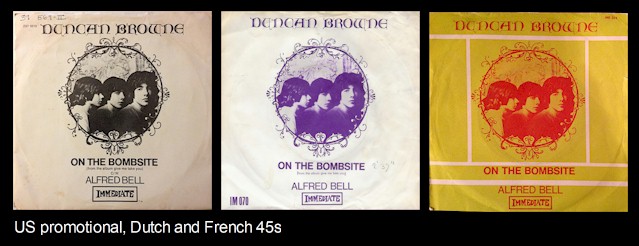
US 7" - 1968's "On The Bombsite" b/w "Alfred Bell" (Immediate catalog number Immediate catalog number ZS7 5010) 2.) I Was, You Weren't (Duncan Browne - Geoff Bretton) - 2:02 rating: **** stars Geez, the church organ opening of "I Was, You Weren't" pushed me back to Catholic mass, but when Browne's vocals kicked in the song blended medieval folk moves with a poppy, harpsichord propelled, multi-tracked vocal arrangement coupled with a playful Bretton lyric. Talk about a strange mash-up. 3.) Gabilan (Duncan Browne - Geoff Bretton) - 4:03 rating: **** stars The only Gabilan I know of is a California mountain range ... Another stark ballad (just Browne accompanying himself with acoustic guitar), "Gabilan" would not have sounded out of place in a religious setting. That was underscored by the Gregorian backing vocals. The song also caught my attention for showcasing Browne's talents as an acoustic guitarist (later in his career he prove equally gifted on electric guitar). 4.) Alfred Bell (Duncan Browne - Geoff Bretton) - 4:30 rating: *** stars The opening segment sounded like a bunch of bratty public school kid chanting their dislike of their teacher "Alfred Bell". That was underscored by Bretton's lyrics which apparently captured the sad life and regrets of an aging school teacher. The sweet melody clashed with the maudlin lyrics. 5.) The Death of Neil (Duncan Browne - Geoff Bretton) - 4:30 rating: *** stars Yes, the lyric is seriously over-the-top dramatic, but I've always wondered if the 10c.c. crowd took their inspiration for "I'm Not In Love" from this tune. The multi-layered angelic vocal harmonies were simply lovely. The lyrics ... well they were a total mystery to me. Inspired by Leonardo da Vinci, a young man who dreams of building a flying machine?
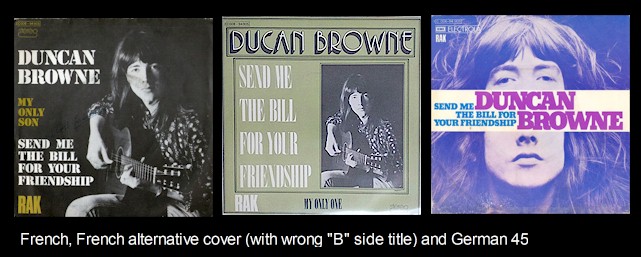
Already in financial trouble, Immediate Records did little to promote the album. The company effectively collapsed shortly after the collection was released. In an effort to raise funds to pay off creditors, Immediate reportedly gave Browne a $6,000 bill for his recording costs. No idea if Browne ever paid the bill, but a couple of years later he got a little payback when he released a non-LP single for Bell:
- 1973's "Send Me the Bill for Your Friendship" b/w "My Only Son" (RAK catalog number 162)
Only 46, after a three year battle with cancer Browne died in May, 1993.
© Scott R. Blackerby August, 2026
|
|
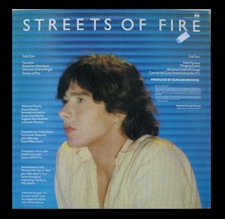
Genre: rock Rating: 3 stars *** Title: Streets of Fire Company: Sire Catalog:
SRK 6080 Country/State: UK Grade (cover/record): VG+/VG+ Comments: original inner sleeve Available: 1 Catalog ID: 3177 Price: $20.00 |
While 1979's 'Streets
of Fire" wasn't Duncan Brown's most consistent album, I've
always enjoyed it as a package more than I have on a song-by-song
basis. It's also one of those albu
"Streets
of Fire" track listing: 1.) Fauvette (Duncan Browne) - 3:54 rating: **** stars Hearing the opener 'Fauvette' and I could instantly see why Sire signed Browne to a contract. Imagine an English, slightly more urbane version of Tom Petty and you'd get a feel for Browne. Like Petty he didn't have the greatest voice you've ever heard, but coupled with a nice Mark Knopfler-styled lead guitar, the song had a likeable, slightly ominous '70s new-wave feel. Come to think of it, Brown's talk-speak vocals actually reminded me a bit of Knopfler's own voice. Easy to see why Sire tapped it as a single. The sound and video quality aren't great, but YouTube has what may be one of the dullest promotional videos you've ever seen: https://www.youtube.com/watch?v=w8IqBxWmkXc
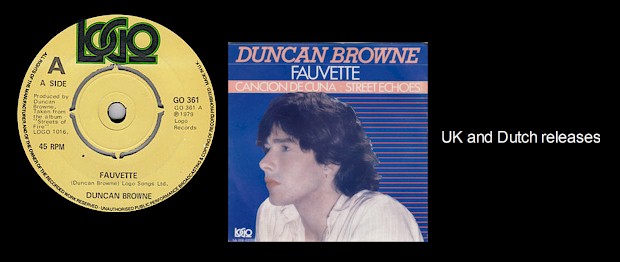
UK release - 1979's "Fauvette" b/w "Streets of Fire" (Logo catalog number GO 361) Dutch release - 1979's "Fauvette: b/w "Caicion de Cuna (Street Echoes)" (Logo catalog number 1A 006-63359) 2.) America Heartbeat (Duncan Browne) - 3:39 rating: **** stars "American Heartbeat" is one of those songs I'm at a loss to explain my affections for. The new wave-tinged melody wasn't anything great; the lyrics were sophomoric; Browne's vocals were at best irritating. But for some reason it all comes together as a tune that's hard to shake out of your head. Maybe John Giblin's bass line had something to do with it. The song was tapped as the album's leadoff single:
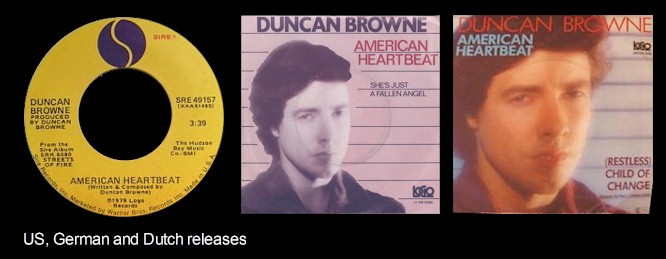
US release - 1979's "American Heartbeat" b/w "She's Just a Fallen Angel" (Sire catalog number SRK 49157) Dutch release: - 1979's "American Heartbeat" b/w "She's Just a Fallen Angel" (Logo catalog number 1A 006-63390) German release: - 1979's "American Heartbeat' b/w "(Restless) Child of Change" (Logo catalog number 0034-018) 3.) She's Just a Fallen Angel (Duncan Browne) - 5:08 rating: *** stars Pretty, fragile ballad that probably goes over better if you're an English major, or have an introverted personality. Dick Morrissey's sax added a touch of adult contemporary supper club jazz to the arrangement. 4.) Streets of Fire (instrumental (Duncan Browne) - 8:09 rating: *** stars The tense, atmospheric opening (Browne on acoustic guitar), has always reminded me of something off an Al Stewart album. That comparison fell by the wayside when the tune shifted over to Brown's urgent electric guitar and jazz-rock fusion motifs. Nice baseline to check out Browne's sadly overlooked guitar chops. Simon Phillips also deserved kudos for his work on the song. A severely edited version of the song was used as the "Fauvette" 45 "B" side.
(side 2) 1.) Nina Morena (Duncan Browne) - 4:56 rating: *** stars I
don't know how many folks remember South African singer Chris DeBurgh
("Lady
In Red"). Personally, I always found DeBurgh irritating. So why
mentioned DeBurgh? Well, the ballad "Nina Morena" has always reminded
me of a De Burgh tune. Yeah, that meant I wasn't a major fan.
The fact one fo the versus was sung in Spanish probably explains why the
song was tapped as a Spanish single:
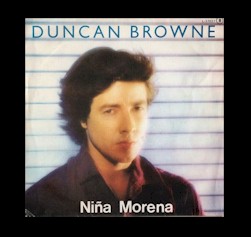
- 1979's "Nina Morena" b/w "Fauvette" (Logo catalog number L-37027)
2.) Things To Come (Duncan Browne) - 5:52 rating: **** stars Hum, "Things To Come" seemingly found Browne shifting into progressive mode ... Peter Gabriel anyone ? Always liked Brown's guitar riff and Tony Hymas' cheesy synthesizers on this one. 3.) (Restless) Child of Change (Peter Godwin) - 3:35 rating: *** stars Geez, who knew Lou Reed could actually handle a melody ? Just kidding, but on this tune Brown's gravelly, sing-speak delivery has always reminded me a bit of the late Reed. Sweet song and the album's lone non-original, penned by Metro band-mate Peter Godwin. 4.) Caicion de Cuna (Street Echoes) (instrumental) (Duncan Browne) - 3:58 rating: **** stars :Caicion de Cuna: ended the album with a pastoral, acoustic instrumental that might not have sounded out of place on Mark Knopfler's "Local Hero" album. One of the album's unexpected highlights.
© Scott R. Blackerby March 2026
|
BACK TO BADCAT PAYMENT INFORMATION
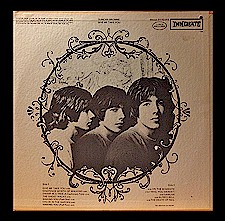 ar
it. The collection featured twelve Browne-Bretton originals. Material
like the title track, "Gabilan"
and "The Ghost Walks"
showcased Browne's sweet, if somewhat
fragile voice over a mash-up of folk, Baroque and pop influences. I do
hear the comparisons to the late Nick Drake (not as deeply introverted),
Colin Blunstone (nowhere near as pop oriented) and Donovan (not as
hippy-dippy). Add in Bretton's erudite lyrics which included nods to
Shakespeare, odes to dwarfs ("Dwarf In a Tree"), sad school
teachers ("Alfred Neil") and Leonardo da Vinci ("The Death of Neil")
you quickly discover the album
wasn't anything like your standard late-'60s pop, or rock release. It also
made for an album that
I've struggled to come to grips with. The magic that so many critics
and listeners discover in these grooves remained largely hidden to my ears.
Still after a couple of years of pulling the album out every now and then,
I've started to understand some of the collection's charms. There's an
"olde England" medieval pastoral
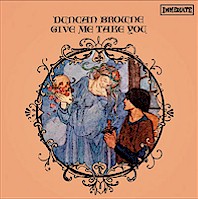
feel to the project (check out Derek Burton album cover) . Life as
it once was - simpler, e
ar
it. The collection featured twelve Browne-Bretton originals. Material
like the title track, "Gabilan"
and "The Ghost Walks"
showcased Browne's sweet, if somewhat
fragile voice over a mash-up of folk, Baroque and pop influences. I do
hear the comparisons to the late Nick Drake (not as deeply introverted),
Colin Blunstone (nowhere near as pop oriented) and Donovan (not as
hippy-dippy). Add in Bretton's erudite lyrics which included nods to
Shakespeare, odes to dwarfs ("Dwarf In a Tree"), sad school
teachers ("Alfred Neil") and Leonardo da Vinci ("The Death of Neil")
you quickly discover the album
wasn't anything like your standard late-'60s pop, or rock release. It also
made for an album that
I've struggled to come to grips with. The magic that so many critics
and listeners discover in these grooves remained largely hidden to my ears.
Still after a couple of years of pulling the album out every now and then,
I've started to understand some of the collection's charms. There's an
"olde England" medieval pastoral
feel to the project (check out Derek Burton album cover) . Life as
it once was - simpler, e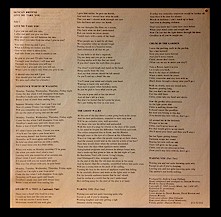 asier
... remember the joys of Victorian romance, life as a member of the titled
gentry, serfdom, Black
Death? If you were a young woman, an English major, or simply a
sensitive persona with a thing for
singer/songwriters, I can see where the combination of young Mr. Browne's
good looks, sweet voice and Bretton's tales of days
gone by might strike near and dear chords. Unfortunately for
the longest time those attributes were largely lost to me.
Compositions like "Chloe in the Garden" and "" were
certainly pretty and Browne's arrangements were intricate and frequently
awesome. Easy to see why Immediate hired him as an arranger. The downside was that with the possible exception of the atypical "
On the Bombsite", the album wasn't going to deliver a kick-in-the-pants
to get your sorry butt moving. Instead the combination of Browne's vocals
and Bretton's lyrics evoked a sense of sadness, or melancholy.
Certainly not an album you'd play to get the party started, but then there
are times when we all need a reason
to sit around and mope, or even have a good cry. And yes, I'll
continue to pull the album out and try to figure out what I'm missing.
asier
... remember the joys of Victorian romance, life as a member of the titled
gentry, serfdom, Black
Death? If you were a young woman, an English major, or simply a
sensitive persona with a thing for
singer/songwriters, I can see where the combination of young Mr. Browne's
good looks, sweet voice and Bretton's tales of days
gone by might strike near and dear chords. Unfortunately for
the longest time those attributes were largely lost to me.
Compositions like "Chloe in the Garden" and "" were
certainly pretty and Browne's arrangements were intricate and frequently
awesome. Easy to see why Immediate hired him as an arranger. The downside was that with the possible exception of the atypical "
On the Bombsite", the album wasn't going to deliver a kick-in-the-pants
to get your sorry butt moving. Instead the combination of Browne's vocals
and Bretton's lyrics evoked a sense of sadness, or melancholy.
Certainly not an album you'd play to get the party started, but then there
are times when we all need a reason
to sit around and mope, or even have a good cry. And yes, I'll
continue to pull the album out and try to figure out what I'm missing.
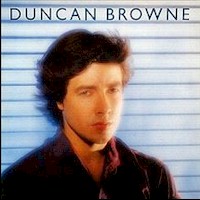
 ms that I'm at a loss to explain my
affections for. With a low, gravelly voice that occasionally
reminded me of Mark Knopfer, Tom Petty or
even Lou Reed, Browne wasn't the
best singer you've ever heard, but on tracks like
"Fauvette" and "Things To Come" there was something quite appealing in his performances. The
fact he was backed by a tight band, including drummer
Simon Phillips and former Metro compatriot John
Giblin on bass certainly didn't hurt the
proceedings. Anyhow, Browne's
fourth studio album in nine years clearly found him looking around for a
marketing niche. The result was an album with a broad, somewhat
unfocused feel. The opener "Fauvette" and "American
Heartbeat" sounded
like they were geared to the Dire Straits and Tom Petty crowd. The
title track instrumental showcased Browne's jazz-rock guitar chops (an
interesting change given his acoustic guitar roots),, while "Things
To Come" demonstrated an unexpected Peter Gabriel influenced progressive rock orientation.
The album's biggest surprise was the atmospheric closing instrumental "Caicion
de Cuna (Street Echoes)"
which sounded like a track off of Mark Knopfler's "Local
Hero" album. (I happen to love the movie and the soundtrack.)
ms that I'm at a loss to explain my
affections for. With a low, gravelly voice that occasionally
reminded me of Mark Knopfer, Tom Petty or
even Lou Reed, Browne wasn't the
best singer you've ever heard, but on tracks like
"Fauvette" and "Things To Come" there was something quite appealing in his performances. The
fact he was backed by a tight band, including drummer
Simon Phillips and former Metro compatriot John
Giblin on bass certainly didn't hurt the
proceedings. Anyhow, Browne's
fourth studio album in nine years clearly found him looking around for a
marketing niche. The result was an album with a broad, somewhat
unfocused feel. The opener "Fauvette" and "American
Heartbeat" sounded
like they were geared to the Dire Straits and Tom Petty crowd. The
title track instrumental showcased Browne's jazz-rock guitar chops (an
interesting change given his acoustic guitar roots),, while "Things
To Come" demonstrated an unexpected Peter Gabriel influenced progressive rock orientation.
The album's biggest surprise was the atmospheric closing instrumental "Caicion
de Cuna (Street Echoes)"
which sounded like a track off of Mark Knopfler's "Local
Hero" album. (I happen to love the movie and the soundtrack.)