Boudewijk de Groot
Band members Related acts
|
line up x (1965-present) - Boudewijk de Groot -- harmonica, guitar
supporting musicians (1975) - Raul Burnett -- percussion - Piet Dekker -- bass - Willem Ennes -- piano and organ - Hans Hollestelle -- guitar - Ernst Jansz -- piano - Johnny Lodewijks -- drums, percussion - Hugo van Riet --- harmonica, guitar - Phil Russo -- guitar
|
- Session - The Tower - Vreemde Kostgangers
|
|
Genre: folk Rating: *** 3 stars Title: Waak Ik Kiin en Wie Ik Ben Company: Decca Catalog: 6419
020 Country/State: Jakarta, Indonesia Grade (cover/record): VG+/VG+ Comments: Dutch pressing Available: 1 Catalog ID: -- Price: $
|
If my father hadn't taken a mid-'1970s job with NATO I never would have lived in Belgium, nor heard of Belgian singer/guitarist Boudewijk de Groot. Not only that, but I wouldn't be trying to learn Flemish on DuoLingo. You can blame my poor language skills and DuoLingo for any shortcomings in the translations below.
As a singer/songwriter (and actor), Boudewijk de Groot is a big deal in Belgium and the Netherlands. Since his 1966 solo debut, he's recorded at least twenty-six albums and scores of singles. Throughout the rest of the world, including the States, he's completely unknown.
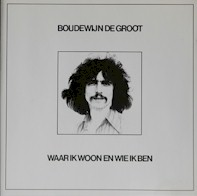
1975's "Waak Ik Kiin en Wie Ik Ben" (translated as "Where I live and who I am" was de Groot's sixth six studio album. Co-produced by de Groot and filmmaker/friend Rene Daalder, the album featuring ten originals. Perhaps his most personal release, the album dealt with everything from the early loss of his mother ("Moeder") to institutional racism in Belgium ("Calpyso") Exemplified by material such as "Waar ik woon", "Of niet som" and "Wegen" most of the album showcased de Groot performing acoustic folk tunes with support from members of the band The Slumberland Band (keyboardist Ernst Jansz, drummer John Lodewijks and bassist Piet Dekker ). The fact de Groot performed in Flemish was certainly going to limit his appeal, but he had a highly commercial voice and a exhibited a knack for catchy melodies to accompany what were occasionally rather sharp and controversial lyrics (check out "Calypso"). Curiously the album was recorded and mixed at Los Angeles' Village Recorders. For anyone curious, de Groot has a nice website at Home - Boudewijn de Groot.nl The site is in Flemish, but the English translation function works well. On the site de Groot talks about recording the album and the inception/inspiration for some of the songs. I don't think he'll mind me borrowing those descriptions.
"Everything
had to change again. After a meeting with Renee Daalder, whom I knew from
the Film Academy, a very intensive collaboration followed. The result was a
collection of lyrics that were about 'Boudewijn de Groot as a well-known
singer in the Netherlands'. There were philosophies underlying it, which
ensured that the entire record, from recording to final mixing, had to sound
a certain way; And also that I (too) carelessly pushed the trusted team
aside and started working with new people. Studio Artisound in Amsterdam had
outgrown the commercials, owner Eli van Tijn had bought a 16-track machine
and I was the first to record an LP there, with Dick de Graaf behind the
dials
So the entire LP is about being a singer in the Netherlands and specifically my being a singer. In America, the technician didn't know what he was hearing: he was much better used to sound. All my guitars have been replayed, the vocals have been re-sung because Renee was on it and 'The Dutch hero' was even provided with completely new music on the spot. In an hour I had to write a completely different melody in the studio. Finally, the whole record was mixed, with Neil Brody, the engineer, sometimes not understanding what we wanted: everything had to be bone-dry with excessive attention to the vocals. With 'Travestie' he completely panicked because he couldn't get the ending, where the whole band is raging at full power, in the right balance. "Leave me and go and have a coffee," I said and fifteen minutes later it was done. After an hour of mixing, a fresh ear works wonders. We started every day at about eleven o'clock and usually left the studio around two o'clock in the morning.
At one point I got a huge swelling on my right forearm. The muscle was overloaded by the incessant guitar playing and in the middle of the night I went to the hospital, where I was told that an ice pack and some rest would fix the matter. Fortunately, that was the case. More was needed for my mental fatigue. But it was a fantastic month there in Hollywood. The record was mastered on the twelfth floor of a building in Hollywood, where the engineer/engineer Alan Zentz had a very old Telefunken 2-track recorder from the '40s. He refused to work on another device. The cover is, still based on the inexorable basic idea, kept entirely in black and white, as sober as possible, without any frills or effect. So exactly as the record was recorded and mixed."
Funny story - Even though I remember seeing this album in Belgian record stores, I didn't buy this album in Belgium, rather found it in a used record store in Rehobeth Beach, Delaware. Would love to know how it got there. = )
"Waak
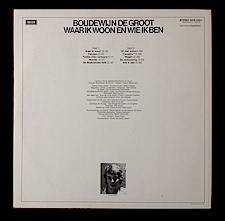
Ik Kiin en Wie Ik Ben" track listing: 1.) Waar ik woon (Boudewijk de Groot ) - 6:16 rating: **** stars "Where I Live" is a song that would be interesting to get a good translation on. Even better to know what it was about. Seemingly a tale of frustration and wanderlust, it started out as a stark acoustic number (de Groot and acoustic guitar). About two minutes in introducing orchestration and a fuller band sound. The refrain seems to be something along the lines of "tonight the world is small". 'Where I live' is about the strange Dutch habit of wanting to appear bigger than we are; reason why we would like to see foreign phenomena in Dutch dimensions: hills where you are supposed to be in Little Switzerland, the PYRAMID of Austerlitz, the VENICE of the North. 2.) Calypso (Boudewijk de Groot ) - 2:05 rating: *** stars I don't have a background in history, sociology or demographics so take these comments with a grain of salt. Add in the fact de Groot's lyrics are in Flemish so my translation and interpretation may be way off the mark. Anyhow, the US justifiably gets slammed for a culture of racisim. The thing is we're not alone in that department. Think Australia and treatment of aboriginal peoples. China and the Uyghurs. South America and native Indian populations. As de Groot seems to make clear on "Calypso", with its own history of colonialism Belgium can join the club. Set to a bouncy Caribbean melody, the tune seems to be highlighting Belgian discomfort with citizens of Surinamese ancestry. Darn it the song didn't reminded me a bit of something out of the Jimmy Buffett catalog. Calypso' is about the 'Dutch negro', whose own music has no influence whatsoever in our country - dit in contrast to that of American Negro music on the music in America. 3.) Rechts links verkeerd (Boudewijk de Groot) - 4:21 The march 'Right, left, wrong' came to us after a long conversation about the mediocrity that I always ascribed to myself: at school not very striking, always grades between 4 and 8, at the Film Academy a very modest student, playing the guitar, but also very mediocre, not an adventurer, not a seducer, in short, cautiously walking on the golden mean. [keybordist] Willem Ennes had great difficulty with the text, because he thought he discovered fascistoid traits in it. You only have to put the words right and left on a marching music and somewhere in the Netherlands a finger referring to the war is raised. That's also what the LP is about. Which does not alter the fact that Willem has played tastefully and convincingly on the record. 4.) Moeder (Boudewijk de Groot) - 3:56 rating: *** stars Inspired by his late Indonesian mother who died in a Japanese internment camp shortly after his birth, "Moeder" was a pretty acoustic ballad (just de Groot accompanied by guitar and a little piano) and clearly one of the album's most personal compositions. ""Mother' originated in Amsterdam on the Spuistraat - coincidentally in the house of a boy with whom I had been in high school - where the high windows reminded me of the rooms I knew from my childhood, where I had often played with my niece. The sound similarity between a gamelan and a carillon was an idea of Renee [Daalder]." No idea when, or where it was filmed, but YouTube has a clip of de Groot performing the song for Belgian television. The camping intro stands in contrast to the sad ballad he sings: Boudewijn de Groot - Moeder 5.) De Nederlandse held (Boudewijk de Groot - Rene Daalder) - 3:29 Another stark ballad,"The Dutch Hero" was largely lost on me. "The Dutch hero' describes the modesty, in every respect, that often continues to 'adorn' the Famous Dutchman in spite of his or her being."
(side
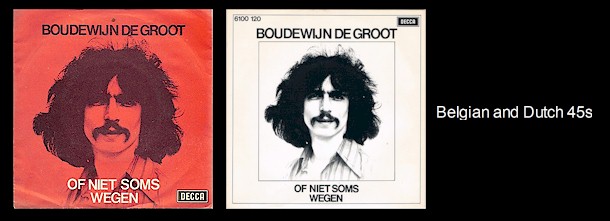
2) "Or Not Sometimes" was another breezy acoustic ballad showcasing some sweet Willem Ennes piano and organ moves and a nice Piet Dekker bass line. The song was released as a single in Belgium and Holland:
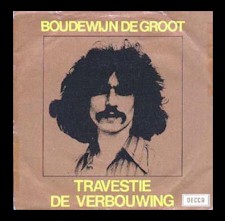
- 1975's "Of niet soms" b/w "Wegen" (Decca catalog number 26 474.Y) 2.) Travestie (Boudewijk de Groot) - 3:58 rating: *** stars No idea what the title meant but with Lolita-styled lyrics (young girl performing some of his songs catches the singer's attention), "Travestie" was definitely disturbing. "You are the beauty, I am the beast ..." About two thirds of the way through Hans Hollestelle's electric guitar kicked in turning the song into the album's sole rocker. de Groot neighbor Anja de Jong sang the refrains and at the end of the song. The song was tapped as a Dutch single:
-1975's "Travesite" b/w "De verbouwing" (Decca catalog number 105-26.482Y)
3.) Wegen (Boudewijk de Groot) - 2:09 With a bouncy, troubadour-styled melody "Wegen" (translated as "Roads") was surprisingly commercial. Once again the song showcased de Groot's sweet, radio friendly voice. 4.) De verbouwing (Boudewijk de Groot) - 3:03 "The Renovation" was another autobiographical number: "In 'The renovation' I report on the renovation that had taken place in our house." The song also appeared at the flip side to his "Travesite" single. 5.) Wie ik ben (Boudewijk de Groot - Rene Daalder) - 4:33 The lyric certainly wasn't groundbreaking ... older man seemingly looking back at the fun times he enjoyed in his youth.
© Scott R. Blackerby December
|
BACK TO BADCAT PAYMENT INFORMATION
 .
The experienced studio musicians had to make way for three-quarters of the
Slumberland Band (Ernst Jansz on piano, John Lodewijks on drums and Piet
Dekker on bass), keyboardist
Willem Ennes of Solution and an American guitarist, Phil Russo, who was very
disappointing in the studio and can only be heard on 'Right, left, wrong'.
The other guitar parts I would have Hans Hollestelle play at the end, with
my head in my lap. There have been evenings when I almost drove home crying,
because I missed the familiar surroundings and because the chaos was simply
too great. But I had to persevere, because I wanted to remain honest with
the basic idea of the record: to deal with the 'old Boudewijn' and to expose
myself completely. In 'Travestie' that thought can be clearly heard. My
neighbor in Heemstede, Anja de Jong, was willing to play the singing fan. In
'The renovation' I report on the renovation that had taken place in our
house. 'Mother' originated in Amsterdam on the Spuistraat - coincidentally
in the house of a boy with whom I had been in high school - where the high
windows reminded me of the rooms I knew from my childhood, where I had often
played with my niece. The sound similarity between a gamelan and a carillon
was an idea of Renee.
.
The experienced studio musicians had to make way for three-quarters of the
Slumberland Band (Ernst Jansz on piano, John Lodewijks on drums and Piet
Dekker on bass), keyboardist
Willem Ennes of Solution and an American guitarist, Phil Russo, who was very
disappointing in the studio and can only be heard on 'Right, left, wrong'.
The other guitar parts I would have Hans Hollestelle play at the end, with
my head in my lap. There have been evenings when I almost drove home crying,
because I missed the familiar surroundings and because the chaos was simply
too great. But I had to persevere, because I wanted to remain honest with
the basic idea of the record: to deal with the 'old Boudewijn' and to expose
myself completely. In 'Travestie' that thought can be clearly heard. My
neighbor in Heemstede, Anja de Jong, was willing to play the singing fan. In
'The renovation' I report on the renovation that had taken place in our
house. 'Mother' originated in Amsterdam on the Spuistraat - coincidentally
in the house of a boy with whom I had been in high school - where the high
windows reminded me of the rooms I knew from my childhood, where I had often
played with my niece. The sound similarity between a gamelan and a carillon
was an idea of Renee.