
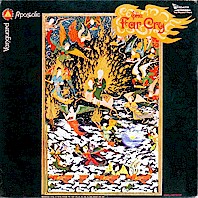
A Far Cry
Band members Related acts
|
line-up 1 (1968-70) - Sean
Hutchinson -- bass
|
- 11th Hour Band (Paul Lenart) - Blue Cheer (Jere Whiting) - Paul Lenart (solo efforts) - Paul Lenart and Larry Luddecke - Dick Martin (solo efforts) - The James Montgomery Band (Paul Lenart)
|
Genre: progressive Rating: *** (3 stars) Title: The Far Cry Company: Vanguard Apostolic Catalog: VSD-6510 Year: 1968 Country/State: Boston, Mass Grade (cover/record): VG+/VG+ Comments: small punch hole top left corner; custom inner sleeve Available: 1 Catalog ID: 639 Price: $70.00 Cost: $1.00
|
Geez, ever heard
the phrase something is "an acquired taste"? Well, it's
certainly an applicable description for Boston's The Far Cry. 1.) Shapes (David Perry) - 4:30 rating: *** stars Opening up with some nice acoustic guitar, "Shadows" quickly shifted into rock territory. In spite of Jeer Whiting's wiled-eyed growling vocals and Dick Martin's discordant sax fills, the track actually had a decent melody and generated quite a bit of energy. I've never seen a copy, but the track was apparently released as a single: -
1969's "Shapes" b/w "Hellbound" (Vanguard catalog
number 35085). Larry Luddecke's
funky opening organ riff gave "Midnight Juice" a distinctive West
Coast psych flavor. And then Whiting's "hey-I'm
being-tasered" vocals kicked in and you were suddenly in Captain
Beefheart territory ("is that doom in your
room?". The funny thing is I'm a big Beefheart fan so
this one held an odd fascination for me. Kudos to drummer Victor McGill
for somehow keeping the song all together. Hearing the jittery rhythm,
I've always wondered if David Byrne owned a copy of this album. Buried
in "Dream?" were the makings of a pretty ballad. Slap on
Whiting's wild voice and extended solos by Paul Lenart
and Dick Martin (hey, I can blow with the cream of Canterbury jazz players),
and this one quickly turned into one wild jam. Add in an extended
McGill drum solo (I mean extended) and in keeping with the band's live
reputation, it was long !!! LOL
- Written by Whiting imagine Wildman Fisher dipping his toes into blues-rock
and you'll get an idea of what to expect from "Hellhound".
The falsetto notes represent the car door shutting on his hand. Elsewhere
Lenart turned in one of his best solos while Whiting demonstrated
some skills on harmonica. (side 1) 1.) Earthlight (instrumental) (Paul Lenart - David Perry) - 3:40 rating: *** stars Opening
up with the focus on Lenart's guitar, the instrumental
"Earthlight" sounded like a mash-up of early Allman Brothers,
Grateful Dead-styled West Coast psych and jazz-rock moves. Once again Martin's
squawking sax solos simply didn't do a great deal for me. Shame as I
would have given the track a fourth star had there been less sax. Their
extended cover of "Sweet Little Angel" demonstrated the band's
good taste in blues, though there wasn't anything here that was going to
make you forget B.B. King's cover. Actually, hearing Whiting's
strained vocals was a challenge, though he was a pretty good harmonica
player. Once again Lenart's
blazing solo stole the show. The closer "Listen to the Walls" reminded me of one of the jazzy tunes a young David Crosby would occasionally kick out. Pretty, soothing and very lysergic ... One of the album highlights. Because he co-wrote the song and given the vocals were smooth and in tune, I think guitarist David Perry handled lead vocals on this one. And yes, Martin was present at the end of the song with his annoying, squawking sax freak-out. I was going to dock the song a star for Martin's participation, but decided McGil's drumming compensated for it.
A mint copy of the album had been in my collection for decades and unexpectedly sold. I can't remember the details other than the buyer was one of the band members who was teaching at George Washington University. (Can't be certain but I think the buyer may have been Steve Perry.)
© Scott R. Blackerby November 2025
|
BACK TO BADCAT PAYMENT INFORMATION
 etween
attending school and rehearsals they started to gain attention playing free
dates at Harvard and clubs like The Alley and The Electric Circus throughout
New England, including New York and New Jersey. By the time they were
spotted and signed Vanguard Records' short-lived Apostolic subsidiary, the
group featured the talents of bassist Sean Hutchinson, guitarist Paul Lenart,
keyboard player Larry Luddecke, sax player Dick Martin, drummer Victor
McGill, guitarist David Perry and singer Jere Whiting. Released in
1968 their self-titled debut teamed them with producer Daniel Weiss. The
album was recorded at New York's Apostolic Studios with sessions spread
across ten days. As soon as the tracks were completed the band members
hightailed it back to school and day jobs. So what's "The
Far Cry" sound like? Powered by Dick Martin's sax
I guess you could label them an early entry to the Canterbury Scene
progressive sweepstakes. But not really. Maybe an early art rock
band? Jazz-rockers? Blues-rockers? Kind of all of
the above and more (sometimes in the same composition). The album
featured largely original material penned by four of the members. The
lone exception was
etween
attending school and rehearsals they started to gain attention playing free
dates at Harvard and clubs like The Alley and The Electric Circus throughout
New England, including New York and New Jersey. By the time they were
spotted and signed Vanguard Records' short-lived Apostolic subsidiary, the
group featured the talents of bassist Sean Hutchinson, guitarist Paul Lenart,
keyboard player Larry Luddecke, sax player Dick Martin, drummer Victor
McGill, guitarist David Perry and singer Jere Whiting. Released in
1968 their self-titled debut teamed them with producer Daniel Weiss. The
album was recorded at New York's Apostolic Studios with sessions spread
across ten days. As soon as the tracks were completed the band members
hightailed it back to school and day jobs. So what's "The
Far Cry" sound like? Powered by Dick Martin's sax
I guess you could label them an early entry to the Canterbury Scene
progressive sweepstakes. But not really. Maybe an early art rock
band? Jazz-rockers? Blues-rockers? Kind of all of
the above and more (sometimes in the same composition). The album
featured largely original material penned by four of the members. The
lone exception was  a cover of Riley King's
"Sweet Little Angel". Musically the set featured a strange blend of jazz, fusion,
blues-rock (check out "Sweet Little Angel")
and psychedelic rock moves. On the extended jam " Midnight
Juice" imagine a band like
National Health or Henry Cow locked into a closet with Captain Beefheart
and Quicksilver Messenger Service's John Cipollina. While it may not have sounded particularly promising, the combination of
styles was occasional quite intriguing. Whiting's voice was best described
as bizarre and wild recalling the likes of Captain Beefheart and Wild Man Fisher.
On tracks like "Shapes" and "Hellhound" it sounded as if he were about to suffer a
terminal stoke, Martin's free form sax gave Canterbury progressive
bands a run for their money and occasionally made you wonder if he was reading the charts for a different
song. Still, there was something fascinating in this aural mess and Lenart's fluid guitar (check
out the introduction to "Earthlight") made for an album I play on a regular
basis. Certainly not for everyone, but for those with an
adventuresome streak, it might be worth checking out. This is simply
one of those album's you need to hear yourself in order to categorize
it.
a cover of Riley King's
"Sweet Little Angel". Musically the set featured a strange blend of jazz, fusion,
blues-rock (check out "Sweet Little Angel")
and psychedelic rock moves. On the extended jam " Midnight
Juice" imagine a band like
National Health or Henry Cow locked into a closet with Captain Beefheart
and Quicksilver Messenger Service's John Cipollina. While it may not have sounded particularly promising, the combination of
styles was occasional quite intriguing. Whiting's voice was best described
as bizarre and wild recalling the likes of Captain Beefheart and Wild Man Fisher.
On tracks like "Shapes" and "Hellhound" it sounded as if he were about to suffer a
terminal stoke, Martin's free form sax gave Canterbury progressive
bands a run for their money and occasionally made you wonder if he was reading the charts for a different
song. Still, there was something fascinating in this aural mess and Lenart's fluid guitar (check
out the introduction to "Earthlight") made for an album I play on a regular
basis. Certainly not for everyone, but for those with an
adventuresome streak, it might be worth checking out. This is simply
one of those album's you need to hear yourself in order to categorize
it.