
Pete McCabe
Band members Related acts
|
line up x () - Pete McCabe -- vocals, acoustic guitar, piano, banjo
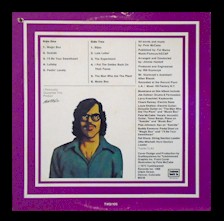
supporting musicians (1973) - Buddy Emmons -- pedal steel guitar - Plas Johnson -- sax - Jim Keltner -- drums, percussion - Larry Knechtell -- kyeboards - Ollie Mitchell -- horns - Chuck Rainey -- bass - Louie Shelton -- \lead guitar - Sid Sharp -- strings
|
- none known
|
|
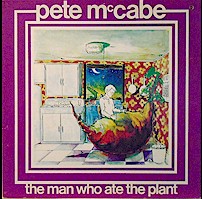
Genre: folk Rating: ** (2 stars) Title: The Man Who Ate the Plant Company: Tumbleweed Catalog: TWS
105 Country/State: Denver, Colorado Grade (cover/record): VG+/VG+ Comments: still in shrink wrap (opened); gatefold sleeve Available: 1 Catalog ID: -- Price: $40.00
|
I stumbled across this album when I bought a couple of Tumbleweed albums at a yard sale - albums by Robb Kunkel, Arthur Gee, Michael Stanley and Pete McCabe. Other than Stanley, these guys were all unknowns to me.
Born and raised in Denver, Colorado McCabe was attending college and playing local clubs when he met singer/guitarist Robb Kunkel. Kunkel had recently been signed by producer Bill Szymczyk to his newly formed ABC-affiliated Tumbleweed Records and was also serving as a talent scout for the label. Kunkel brought McCabe to the attention of Tumbleweed management who were intrigued with his home demos and signed him to a contract.
Peter
McCabe's fan base isn't large, but those fans are dedicated labeling him a
"genius" and this 1973 solo album a "masterpiece".
Personally I don't get it. Pretty much everything the fan base likes
about the Bill Szymczyk produced "The
Man Who Ate the Plant" irritates me. So where to
By the time the album was released Thumbleweed was surviving on fumes, meaning McCabe and the album received virtually no promotion. That effectively spelled the end of his professional musical career for the next forty years, though he continued to write and record music for his own entertainment. McCabe got married, moved to Southern California and worked in graphics design before shifting to education where he worked with special education students. In 2014 he released a CDr format album on the small Dutch Disco Fair label "Multiple Choice". That's been followed by a string of self-released collections.
Robert Pally interviewed McCabe for The Perfect Sound Forever website in August 2012: Perfect Sound Forever: Peter McCabe
McCabe has a webpage at Pete McCabe | about.me and a Facebook site at: (2) Facebook
"The Man
Who Are the Plant" track listing: 1.) Magic Box (Pete McCabe) - 4:57 rating: ** stars "Magic Box" was a warbly singer-songwriter tune featuring stoned lyrics and Jimmie Haskell's needless heavy orchestration. Buddy Emmons added pedal steel guitar Pleasant, but even after reading McCabe describe the song, I'll be darned if I really understand the plotline. Here's what McCabe had to say about the song: ""Magic Box" was actually the first tune we recorded and the chart for the song had about five pages because it has so many different endings. I was really nervous because I had never really played with anyone before and here I was sitting there with this quartet of top session players and I was going to have to play these songs without singing them and I kept forgetting which ending we were supposed to be coming to and going into the wrong ending. I distinctly remember going into the men’s room and looking into the mirror and saying “Pete you’ve got to get it together, this is your big shot, you got to play this tune!. I had been reading a book of short science fiction stories, most of the entries in this thing were two or three pages long, and there was one story about a travelling magician that came through a little town. He had a big crowd of people out in a field and he levitated a person who went up into the air and disappeared from sight and that was basically the whole story, so that kind of gave me the idea thinking about a magic man who makes people disappear." Recorded at a July 2010 performance at Santa Monica's Dakota Lounge, YouTube has a solo performance of the song: Pete McCabe - "Magic Box" 2.) Suicide (Pete McCabe) - 2:05 McCabe's comments on the song: "This was written on my upright piano in my Capitol Hill apartment in Denver. As one who was never very successful with the ladies, I was depressed to see everyone walking around in love while I played the blues. I asked Jimmie Haskell to arrange it with a big band. Plas Johnson played a nice sax solo. It took Keltner just a few minutes to work out the syncopation during the instrumental break. My voice cracked unexpectedly but in a fun way, going up to a falsetto on the last chorus." 3.) I'll Be Your Sweetheart (Pete McCabe) - 4:07 ""I'll Be Your Sweetheart" was the second song we recorded because both it and "Magic Box" had Buddy Emmons playing pedal steel on them. He was one of the first to arrive and he was just warming up and he was playing these amazing chords I didn’t think you could play on a pedal steel, I was just amazed at that. On the charts for Magic Box, from my discussions with Jimmie Haskell, it said for pedal steel “SCI Fi not C&W”, and Buddy said, What is that? Well, science fiction not country and western and even though it sounds like a synthesizer on there that’s the pedal steel." 4.) Lullaby (Pete McCabe) - 4:37 rating: ** stars "Lullaby" was another fragile ballad. The combination of McCabe's "Kermit the Frog" vocals, prententeous lyrics and Haskell's heavy orchestration left me cold to this one. 5.) Feelin' Lonely (Pete McCabe) - 1:42 rating: * star 'Feelin' Lonely" was a discordant banjo powered slice of hillbilly bluegrass. Imagine The Lovin' Spoonful deciding they wanted to see if they could chase an audience out of a club. Truly one of the album's weirder numbers. Fans point to this one as genius, but it just leaves me shrugging my shoulders.
(side
2) 2.) Late Letter (Pete McCabe) - 2:46 rating: *** stars The pretty banjo powered "Late Letter" started out as the album's most "normal" sounding song. Seemingly a fans tribute to Marilyn Monroe, the track demonstrated McCabe could actually carry a tune. I've always wondered why McCabe titled it "Late Letter". 3.) The Experiment (Pete McCabe) - 3:04 rating: *** stars Featuring Larry Knechtell on harpsichord "The Experiment" was lyrically dense and melodically thin. With his vocals multi-tracked, McCabe's reflections on what was seemingly a failed romance were mildly entertaining. McCabe's described the song's meaning: "With "The Experiment" I was in the fifth year of art college trying to get a degree, which actually never happened because I dropped out as soon as I got the record contract. One of the things I had to do was I had to take a psychology class and I think some of that terminology, the notion of proving a hypothesis, being an unbiased experimenter, I really wasn’t that great in the class, but I came away with some of those ideas. I had a girlfriend at that time and eventually broke up with her and was starting in with another one and it seemed like we really were not all that compatible, it seemed like both of us felt life was mostly winter. "The Experiment" was about that, looking at a romance in terms of it being an experiment." 4.) I Put The Smiles Back On Their Faces (Pete McCabe) - 2:50 rating: * star What in the world ... McCabe obviously had an eclectic childhood. "Before the record Bill Szymczyk and his assistant Alan Blazek had got me to come over and play them all the good tunes I had so they could go through them and pick out the ones to do. and they came to "I Put The Smiles Back On Their Faces" they said, "That’s kinda interesting but what the heck is that song about?" I said it was about a paranoid mortician and as soon as I said that, they got the whole song. I put the smiles back on their faces is what he does for a living. As a child I used to stay over at my grandmother’s in this house I had a nostalgic feeling for but it was also kind of a scary house. And I just remember brushing my teeth late at night there and there was a big banister down the hall and it was all dark. What’s out there waiting for me? So a little of the paranoia came from that, I guess." 5.) The Man Who Ate The Plant (Pete McCabe) - 2:48 rating: * star The title track was one of the first tunes McCabe wrote, stretching back to his time in junior high school playing with the folk group The Timbermen. Showcasing McCabe on keyboards and banjo this "heartbreak" ballad has always reminded me of a mash-up of Randy Newman and Kermit the Frog. Anyone care to hazard a guess what it's about? I've always wondered what the sessions musicians thought about this one. It was selected as the album title since McCabe and company couldn't come up with a better title. MCCabe's description of the song: "For the song "The Man Who Ate The Plant" I felt like I was almost channelling something strange there because that was a very early banjo tune and I was just playing these C minor chords over and over again until something struck me as the kind of words that should go to it, and this mysterious song emerged. It took place in this alternate universe where no one had ever eaten a plant before and how the neighbourhood might react to someone who did something so strange. That’s probably the most psychedelic tune on the record but that was way before I heard anything about drugs. Of course by the time I made the record that was a big part of my life for some time." 6.) Music Box (Pete McCabe) - 5:04 rating: * star As expressed below, McCabe's fears about being overwhelmed by the orchestration pretty much came true. "Music Box" is certainly about being frustrated with trying to link with the opposite sex. I did notice that sometimes women seemed to be very interested in me as a musician but that was about it. At that time I was starting to write piano tunes and "Music Box" and "Suicide" were the only two I had at the time and I didn’t realise that Szymczyk had in mind that "Music Box" was going to be the giant production number that it was. I was trying to keep up with the rhythm section because they really took off at the end. When we overdubbed the strings and horns it was pretty boffo. That tune had so many instruments on it, I believe it had thirty pieces and it was really fun to sit there and listen to this orchestra on these giant speakers. Though from time to time, not knowing that much about studio recording I was secretly afraid I was going to get covered up by all these instruments, but Bill just wanted to hear them nice and loud when he was putting down the basic tracks."
© Scott R. Blackerby January 2026
|
BACK TO BADCAT PAYMENT INFORMATION
 begin? The album was recorded at L.A.'s Record Plant with backing from
a "A" list of studio professionals
and arrangements from Jimmie Haskell. You have to wonder what guys
like drummer Jim Keltner, keyboardist Larry Knechtell and
guitaristLouie Shelton were thinking during these sessions.
The eleven original compositions uniformly featured McCabe performing
fragile, highly eclectic singer-songwriter material. Exemplified by
tracks like "Suicide", "I
Put The Smiles Back On Their Faces" and "The Experiment" the
album was lyrically dense, obscure and personal, but these tunes were also
incomprehensible. Even with McCabe's explanations tunes about aliens,
paranoid mortician and Marilyn Monroe left you shaking your head going
"what in the world?". McCabe's voice was also
... well interesting. While the fans loved the "real
person" ethos in his delivery, I found McCabe reminded me of Kermit the
Frog-meets-Randy Newman. It's an album I've listed to a dozen times
over the years. Each time I've wondered "what am I missing here?
Maybe it I give it another spin ..." I'm still at a loss.
begin? The album was recorded at L.A.'s Record Plant with backing from
a "A" list of studio professionals
and arrangements from Jimmie Haskell. You have to wonder what guys
like drummer Jim Keltner, keyboardist Larry Knechtell and
guitaristLouie Shelton were thinking during these sessions.
The eleven original compositions uniformly featured McCabe performing
fragile, highly eclectic singer-songwriter material. Exemplified by
tracks like "Suicide", "I
Put The Smiles Back On Their Faces" and "The Experiment" the
album was lyrically dense, obscure and personal, but these tunes were also
incomprehensible. Even with McCabe's explanations tunes about aliens,
paranoid mortician and Marilyn Monroe left you shaking your head going
"what in the world?". McCabe's voice was also
... well interesting. While the fans loved the "real
person" ethos in his delivery, I found McCabe reminded me of Kermit the
Frog-meets-Randy Newman. It's an album I've listed to a dozen times
over the years. Each time I've wondered "what am I missing here?
Maybe it I give it another spin ..." I'm still at a loss.