
New Hope
Band members Related acts
|
line up 1 (1970) - John Bradley -- vocals, guitar - Kit Stewart (RIP 2001) -- drums, percussion - Carl Von Hausman -- keyboards - Ron Shane (aka Ron Cichonski) -- bass
supporting musicians: - Rufus Harley -- bagpipes - Bob Hartnagle -- - Len Pakula -- - Al Price -- - Pal Rakes --
|
- The Kit Kats - The Pablo Ponce Four - Roscoe & the Green Men (Karl Hausman) - The Tak Tiks - Carl Von Hausman (solo efforts)
|
|
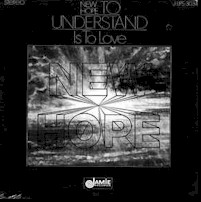
Genre: pop Rating: 3 stars *** Title: To Understand Is To Love Company: Jamie Catalog: J
LPS 3034 Country/State: Philadelphia, Pennsylvania Grade (cover/record): VG+/VG+ Comments: -- Available: 1 Catalog ID: 5 Price: $20.00
|
So here's a story of managers and marketing run amuck.
By 1969 the Philadelphia-based Kit Kats had enjoyed some regional successes and a minor national hit with the single 'Won't Find Better Than Me'. They'd actually released the song twice. In 1969 Mike Aspey signed on as band manager. One of his first suggestions was the band re-record 'Won't Find Better Than Me' for the third time with a slightly updated arrangement. Aspey also convinced the band it was time for a new name. Perhaps it sounded hipper, but the name change was apparently inspired for no good reason other than the fact New Hope, Pennsylvania was nearby. Regardless, The Kit Kats became The New Hope. The New Hope featured the same line-up - singer/guitarist John Bradley, drummer Kit Stewart, keyboardist Carl Von Hausman and bassist Shane. They were signed to the same label (Jamie), retained most of their old sound and even ended up re-recording several of the old Kit Kat tunes.
Produced by Aspey, 1969's "To Understand Is To Love" sounded a lot like a Kit Kats release. Your feelings about the album depended largely on what you thought about The Kit Kats. That said, the album was kind of a mess. While the band members had quite a bit of new material, much to their frustration Aspey was interested in having them rerecord even more of their existing catalog. In addition to 'Won't Find Better Than Me', there were seven other Kit Kat remakes - 'Let's Get Lost On a Country Road', 'Breezy', 'Find Someone', 'You're So Good To Me' and 'You've Got To Know', 'Distance'. 'Won't Find Better Than Me' was actually represented by two other selections. First there was a hideous medley of '50s tunes entitled 'Won't Find Better Than Me - medley' and the closing song fragment 'Gregorian' which was nothing more than the band singing part of 'Won't Find Better Than Me' acapella. The album included four covers - Brian Wilson's 'You're So Good To Me' , 'Distance', the bland ballad 'They Call It Love' (conveniently co-written by producer Aspey) and the Ralph Dino and John Sembella penned 'Rain'. The set was rounded out by two new originals - 'Look Away' and a searing 'The Money Game.' The two original tunes were an indication of the direction the band was interested in pursuing and served as the album's two strongest performances. While most of the album sounded distinctly old-fashioned there was no denying that many of the performances were quite appealing. If you'd never heard the Kit Kat originals then there wasn't anything wrong with starting here. The sad thing and missed opportunity lay in the two new originals. You can only wonder what the band might have done given the opportunity to experiment and record more original material.
"To
Understand Is To Love" track listing: 1.) Won't Find Better Than Me (Carl Von Hausman - Kit Stewart) - 3:47 rating: **** stars Spotlighting John Bradley's unique voice, 'Won't Find Better Than Me' was one of those songs that must have sounded old fashioned the minute it was released. Even with the Von Hausman's extended piano and harmonica introduction and an updated commercial arrangement, the revamped song sounded very 1964 versus 1970. As for guitarist Bradley lead vocals; his high, thin voice managed to make Frankie Valli sound like a rugged blues man. The Frankie Valli comparison really wasn't that far off since the song had an early Four Seasons vibe. By all rights I should hate the song, but for some reason I find it a guilty pleasure. Maybe that attraction stems from the fact it sounds so old fashioned ... Still, I like the Kit Kats original arrangement better.
- 1969's 'Won't Find better Than Me' b/w 'They Call It Love' (Jaime catalog number 1381)
2.) Won't Find Better Than Me - medley (Carl Von Hausman - Kit Stewart) - 2:06 rating: ** stars I'm not sure what the thought was including a hodgepodge of '50s, early '60s song fragments (Chuck Berry, Jerry Lee Lewis, The Penguins, etc.) under the title 'Won't Find Better Than Me - medley.'. The ill advised medley ended with a brief revamped '50s version of the hit. Maybe it was intended to show they'd be entertaining if you hired them for your next office party? You won't need to listen to this one more than once. 3.) You're So Good To Me (Brian Wilson) - 2:12 rating: **** stars Another Kit Kats remake, on the heels of the dreadful medley, 'You're So Good To Me' was something totally different - imagine a late-'60s slice of bubblegum pop mixed with early-'70s British AM rock (something along the lines of The Cowsills-meet- Pickettywitch). Even though it wasn't as energetic as the original, if you were going to pick a top-40 single, this should have been it. 4.) Distance (R. Gilmore - Joe Renzatti) - 2:28 rating: **** stars Another Kit Kat remake, the updtaed 'Distance' sported a pleasant and commercial contemporary pop sound. Nice pounding beat; memorable melody and nice vocals would have made it another good choice as a single. 5.) Let's Get Lost On a Country Road (Carl Von Hausman - Kit Stewart) - 2:24 rating: **** stars Yet another Kit Kats remake, the song title certainly wasn't very promising and true enough, 'Let's Get Lost On a Country Road' started out with some of the most irritating falsettos you've ever encountered. And just when you were ready to pick up the needle and move on to the next tune the song landed back in Four Seasons territory with a weird banjo interlude. Geez, then the falsettos came back. One of the strangest tunes I've ever heard. This version apparently reused the original Kit Kats track with stereo horns added to the mix. 6.) Breezy (Carl Von Hausman - Kit Stewart) - 2:49 rating: *** stars Imagine a 19th barber shop quartet waking up in the 20th century ... This was another track that I should have disliked, but found fascinating given how old school it sounded. To my ears it didn't sound all that different from the Kit Kats original. 7.) You've Got To Know (Carl Von Hausman - Kit Stewart) - 2:42 rating: **** stars Von Hausman's pounding keyboards sounded like something out of the Motown catalog, but the vocal arrangement sounded like Spanky and Our Gang without the benefit of Spanky. Once again the song was far better than you would have ever expected with a chorus that managed to overcome a slew of other musical sins including Bradley's thin and shrill vocals. Another remake that wasn't as good as the Kit Kats original, but was still fun.
(side
2) 'Look
Away' was a good example of what could have been. The song featured a
lengthy folk-rock arrangement with nifty instrumentation including
accordion, martial drums and Rufus Harley on bagpipes. The combination
took the song in a totally unexpected direction that recalled a
Scotish marching band. Add in some damning lyrics from Stewart, their
beautiful harmonies and you had one of the album highlights. Not sure
how or why it worked, but it did. It was also an audacious choice as
the album's third and final single, perhaps explaining why it did poorly in
terms of sales. Having heard the 45, let me advise you to stick with
the unedited album track. The 45 version deleted much of the
instrumental work, including most of Harley's bagpipes.
- 1970's 'Look Away' b/w 'The Money Game' (Jaime catalog number 1388)
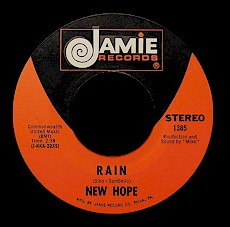
2.) Find Someone (Carl Von Hausman - Kit Stewart) - 2:35 rating: ** stars Previously released as a 1968 Kit Kats single, their update of 'Find Someone' was just as uninspired as the original. Opening up with some Von Hausman barrelhouse piano, the song sounded like something you'd hear at a roller rink. Relentlessly upbeat, this one was just plain cloying. No idea why the song faded out and then returned for a brief instrumental encore. 3.) They Call It Love (Lamp - Mike Apsey) - 2:49 rating: * star One of the new tunes, 'They Call It Love' was a plodding ballad that really had nothing going for it. Stewart's vocals sounded precious while the whole band sounded bored. That may have something to do with the fact producer recorded the track with studio musicians. The band merely provided the vocals. 4.) The Money Game (Carl Von Hausman - Kit Stewart) - 3:28 rating: **** stars Another new song, 'The Money Game' sounded like it had been recorded in a basement prison cell. In spite of the flat sound it was the album's biggest surprise, sounding nothing like the rest of their catalog. In a rare move, Stewart was featured on lead vocals. While he didn't have a great voice, he sounded major league pissed off as he took aim at the downsides of the music business and society in general. Bradley added some sizzling fuzz guitar showing they could actually rock out if needed. Not sure why, but every time I hear Stewart's growling voice it makes me think of Joel Grey and Cabaret. 5.) Rain (Ralph Dino - John Sembella) - 2:33 'Rain' was another track recorded by producer Aspey with studio musicians. The band members were brought in to provide the vocals - in this case Bradley and Stewart sharing lead vocals. As a cover the song was clearly picked for its commercial appeal. The tune was pretty enough, but to my ears the results sounded overly polished. I did like the freak-out weather sound effects at the end. The song was tapped as the album's second single:
- 1970's 'Rain' b/w 'Let's Get Lost On a Country Road' (Jaime catalog number 1385
6.) Gregorian (Carl Von Hausman - Kit Stewart) - 0:19 rating: * star 'Gregorian' was simply the first verse of 'Won't Find' sung like a group of monks; it was intended as a joke but even Karl found it embarrassing.
- 1971's 'Taking My Time' b/w 'That You Love' (Paramount catalog number PAA 0110).
As The Kit Kats they band continued to play occasional live shows throughout Pennsylvania through 1974. There were also a couple of ill-advised reunions. Drummer Stewart died in 2001.
If you want to read more about The Kits, or The New Hope the Spectropop group has an extended (and do I mean extended) piece on the groups at: http://www.spectropop.com/KitKats/
NEW HOPE A fortunate turn of events for Jamie also proved pivotal for the Kit Kats that year. Jamie/Guyden picked up a small Florida label, Sundi, whose release of Mercy's 'Love (Can Make You Happy)' was burning up the charts in the Sunshine State. With Jamie's distribution, the record became a national smash in the spring and summer. One of its producers was the eccentric Mike Apsey, who convinced Harold Lipsius to hire him to work for Jamie. He became the Kit Kats' new producer, although it was not quite as cosy an arrangement as the band had once enjoyed with Bob Finiz. Whereas Finiz attended the band's shows frequently, Apsey was only an occasional spectator. The Kats had socialized with Finiz, while their relationship with Apsey was more businesslike. Apsey seems to have been more interested in Karl than the rest of the group; he would call Karl into the studio to add background parts or smooth out rough edges after the foursome had laid down their tracks. Nonetheless, the producer had one hell of a trick up his sleeve: recording yet another version of 'Won't Find Better Than Me' to be released undoubtedly as an A-side. Karl came up with a gorgeous new arrangement, placed firmly in the soft rock vein but with all the elements of the Kit Kats' sound: powerful drumming, country-rock guitar work, lively bass, and classical piano. A slight Latin tinge made the record all the more distinctive. The band's signature harmonies were as strong as ever, but Karl reveals that he played a bigger role in them than usual: "On 'Won't Find Better Than Me', I'm the only one doing background. We eliminated the three-part harmony that was on there, and I think I said, with no - you know, not cutting out the other guys - but I said, 'Bottom line is, we want it to sound better.' And so what I did was just work with Mike, and I just kept doing vocals in layers ... 3 of my own voices, and that's it. And it worked out fine." Since the song had already been out twice under the Kit Kats name, Apsey (credited as Mike for some reason) thought that a new name was in order. New Hope, Pennsylvania was (and is) a small town known for its tourist-baiting arts scene; thus Apsey chose to rename the band the New Hope, which was later shortened to New Hope. Karl was happy to lose the Kit Kats moniker, but he didn't think New Hope was much of an improvement: "I said, 'Mike, you have to look at it as a cynical Philadelphian. People are gonna call us No Hope!' And sure enough, we did [veteran Philly deejay Ed Hurst's afternoon dance show]. So one day he introduced us as New Hope and he said, 'Oh! I almost said No Hope.' I said, 'Son of a bitch, I was right!'" Fortunately, the band lived up to the name New Hope, not No Hope. The new 'Won't Find Better' was released at the end of 1969 and, in the biggest development yet in the group's lifetime, made Billboard's Hot 100 in January of 1970. It peaked at #57 in a nine-week chart run, but it was a much bigger hit in many cities across America. Why did this record do so much better than anything before it? Karl's answer is simple: "I think it sounded good." At any rate, Jamie rewarded the guys by sending them on all-expenses paid trips to the record's biggest cities whenever the band was available. It's worth noting that at the clubs back home, the group stuck with the name the Kit Kats because it was still a draw under that name. The next New Hope single came in April, and it was a peculiar offering. 'Rain' was a catchy tune from outside writers, but its soft rock sound was a tad too sweet and polished; not surprisingly, the instrumental tracks were cut with session players. John, Kit (who takes the lead on the bridge), and Karl were the only Kit Kats on this record, and their contributions were strictly vocal. Even though it followed a hit single, 'Rain' failed to make a splash. Oddly, the B-side was 'Let's Get Lost On A Country Road' with horn overdubs, showing that Mike had a somewhat unhealthy obsession with the Kit Kats' oldies. Karl remembers that Mike "liked our old material and wanted to do 'em over again. And even I said, 'Why? Kit's got songs, I've got songs … we've got a whole bunch of new stuff'… but somehow they felt like they should [laughs] just take our old songs, basically, and take some of the echo off. And that was it! And then of course we re-recorded some of the songs." TO UNDERSTAND IS TO LOVE These bizarre ideas led to a mess of an album. To Understand Is To Love (commonly referred to as The New Hope LP) was released in August to undeservedly good sales. The album was a pathetic mishmosh that was never quite what it seemed to be. Apsey had Karl record a long piano-and-harmonica intro for 'Won't Find' and tacked it onto the main track; somebody (perhaps Kit) also added an unnecessary tambourine overdub. 'Gregorian' was simply the first verse of 'Won't Find' sung like a group of monks; it was intended as a joke but even Karl found it embarrassing. 'You're So Good To Me' was included in a weak stereo mix that surgically removed the 45 version's "balls", while Apsey presented 'Distance' in stereo with the first half of the intro lopped off. 'Country Road' appeared with the original mono 45 master drowned in obtrusive stereo horn overdubs, while 'Breezy' was resurrected in mono with some stereo elevator music thrown on at the beginning. The guys re-recorded 'You've Got To Know' in a deliberate tempo meant to rectify the excessive speed of the original, but the new version lacked the original's fire. 'Find Someone' also got a needless makeover, with smoother but less interesting harmonies and an instrumental tag that segued awkwardly into 'They Call It Love', the dull soft popper that had occupied the B-side of the first New Hope single. [25] The ridiculous 'Won't Find Better Than Me Medley' was not even supposed to be released, nor did it take shape as originally planned. Karl had the idea to do 'Won't Find' in the styles of various '50s artists, with each singing Kat taking his turn on lead. However, Apsey insisted that he had to leave town and rushed the band to finish the album; thus, Karl sang all the 'Won't Find' segments and Apsey broke them up with snippets of the Kit Kats' covers of 'Need You' and Bertha Tillman's 'Oh My Angel'. [26] Karl's memories of this artistic misfire are understandably bitter: "It wasn't supposed to happen. It was just something I came up with and thought it'd be fun to do for the hell of it, I think for our own enjoyment. Give the guys each a copy and send us home. And he stuck it in the album and I thought, 'Nobody's gonna understand this! It makes no sense!'" With 'Rain' also on board, the album was starting to look like a loser. Fortunately, the fantastic foursome provided two new originals that showed promise - even if they were both rather extreme departures from the Kit Kats' formula of churning out goodtime pop tunes with traditional boy-girl storylines. 'Look Away' was a long, progressive pop opus with extended instrumental passages and choir-like vocals. Kit's lyrics were so obsessively preachy that they bordered on nitpicking: "People talking everyday, but ask them what they want/Speak their minds in every way, but never lift a thumb/Always want to have their say, but saying's all they want." But the point that some people talk a great talk and never actually do anything was a good one, and the musical experimentation was really the main attraction of the recording. Karl's vibrant piano and accordion solos ('Won't Find Better Than Me' is in there somewhere) were complemented by some very cool bagpipes, which came about because Karl wanted to go for a Scottish marching band feel. To achieve this end, Jamie hired Rufus Harley, master of the jazz bagpipes. [27] Karl has fond memories of the off-the-wall jazzman: "I remember, he comes down - a really elegant guy, you know, and he had one of these Yemen-type caps on, and he goes into the office and he says, 'Yeah, I'll do the session! I got my bagpipes with me … I want 400 dollars.' Jamie says, 'Will you take 100?' He said, 'Sure!' So that was a quick settlement! So he comes upstairs and he said, 'Uh-huh! Glad to be workin' with you guys!' And we said, 'Oh, we're honoured you're here!' And the funny thing, he really just made us laugh when he opens up the case, takes out the bagpipes and says, 'We'll be in business soon as I blow these motherfuckers up!' [laughs] So anyway, he did, and he played right along with us, and we had a fun afternoon with the guy." Fun was not in order for the other new selection, 'The Money Game'. Though rock critic Richie Unterberger resists no opportunity to compare this track to the Easybeats, it was actually inspired by the Beatles. Karl had composed a soft and lilting melody a la 'Martha My Dear', but Kit's lyrics were unexpectedly hard-hitting: "All the things that I've been thinkin', all the things I say/No, I never would be heard, no, without the money game!" So Karl upped the ante on the arrangement: "I said, 'John, get a fuzz-tone. And I want Kit to do his boom-bum-bum-boom,' which is basically a strip beat speeded up. And I said, 'I'll just do the piano more classical.'" Kit laid down a vicious lead vocal, and the track rocked harder than anything the band had previously committed to vinyl. The two "statement songs" were paired on a 45 that August, but 'Look Away' rode on the A-side in a most altered state. As Karl laments, "I rode with Harold Lipsius to New York, and we took it up to a studio - I don't remember which one ... we spend the afternoon while we watch the engineers MURDER MY BABY! And I told them, 'You murdered my baby!!!' And the engineer looked at me and he said, 'Ah, you Beethovens are all alike! Look, you hand me a seven-minute song, I gotta cut it down to three - don't worry so much! It'll sound great on the jukebox!'" That engineer was wrong. The 45 edit of 'Look Away' was indescribably horrible; the word "abomination" does not even come close to explaining what a pointlessly embarrassing train wreck it was. Not surprisingly, it tanked, and that proved to be the last straw for the band. They were disillusioned that they had not become bigger after so many years and depressed that Jamie could not build on the new hope offered by the success of 'Won't Find Better'. They'd had great expectations for 'Look Away', but the failure of that song put them further in the dumps than they'd been in a long time. They were ready for a change, and one was about to come their way thanks to an extremely unlikely source. PARAMOUNT In November of 1970, Kit received a phone call from a producer who wanted to offer the band a deal with Paramount Records. That producer's name was Bob Finiz. Finiz was now working for Koppelman-Rubin Productions and had contacts at Paramount, a label he believed could promote the Kats better than Jamie. The band still felt the sting of the lawsuit, but Finiz made nice with them and set up a meeting with Charles Koppelman in New York. Koppelman asked the guys to return to the Big Apple and do a live show for some of Paramount's staff, which they did in early 1971. Duly impressed, Paramount agreed to sign the group, who reverted to the name the Kit Kats because that was still the name under which they were the biggest draw. [28] Finiz took them into Media Sound Studios in New York to cut their Paramount debut, 'Taking My Time'. It was a simple number, but Kit's lyrics really packed a punch. With lines like "People talkin' and they wonder why I don't have time to make some money," and "Taking my time, taking it slow/Nobody's shown me where to go," it was the unmistakable anthem of the average American 20-something: he's confused and desperate to find a direction in life, but people would rather bug him about it than actually help him find something he can really sink his teeth into. You might consider it a close cousin of the Beach Boys' 'I Just Wasn't Made For These Times', except Brian Wilson was in his twenties when he wrote that tune, while Kit was a full 31 years old when he penned the lyrics to 'Time'! And Kit's inclusion of the line "I fill my body with the magic wine, I wonder why my life's still lonely" raised Karl's eyebrows: "I listened to this, I said, 'What, are you on drugs now?' He said 'No!' [laughs] I said, 'Your lyrics have changed! It's no more June, croon, spoon, honeymoon crap!'" Sadly, the potent lyrics and Karl's strong melody were sabotaged by Bob Finiz, who insisted on an annoyingly gimmicky arrangement. Finiz called for tempo changes, abrupt stops and starts, and a fast cadence. Karl: "I said, 'For Christ's sake! It's not a march!' By the time it was finished, it sounded more like I could picture the seven dwarves marching …" Karl does admit that he asked for the goofy horn overdub (which was done at Finiz's house in Cherry Hill, New Jersey), but he also admits that it "sounds dumb now." There were some tasty Rock-Si-Chord passages, but Finiz edited out the lengthy psychedelic instrumental breaks so that the song would clock in at slightly over two minutes - an unnecessarily short running time for an early '70s single. Still, 'Taking My Time' had a lot to offer, and with the promotional backing of a larger label it stood a good chance of taking off. Released in the fall of 1971, it went absolutely nowhere. "Not a great promotion staff, Paramount," moans Tom Kennedy. "That was Famous Music, and I don't think they could deliver lunch in a bag." Too bad, because the B-side of 'Taking My Time' was an especially delicious feast. 'That You Love' came totally out of left field, with lyrics like "I know what I have to be and it offends you/It ain't natural, so you say/For someone to love my way/If you think I'm wrong, I wish you'd understand: it's not who you love, it's not how you love, it's that you love." The song was of course light years ahead of its time, and it was written solely by Karl [29], which is quite surprising in retrospect. After all, Kit had clearly developed an interest in statement songs, but what possessed Karl to get on his soapbox as well? As it turns out, Kit had something to do with it. One night in 1971, he invited Karl to see the Frisco Follies, a gay revue featuring male performers who impersonated female singers such as Barbra Streisand. Karl was not terribly keen but Kit convinced him to give it a chance; Karl ended up enjoying the show and was particularly moved by what one of the performers said at the end: "Just remember, ladies and gentlemen: It's not who you love; it's not how you love; it's that you love." Karl was in complete agreement: "I said, 'You know? They are RIGHT! Absolutely right! It's that you love! Nobody's ever hurt anybody with that.' And it was sometime after that I went down just a few months later and I came up with that song. And I thought, 'I'm gonna write something in defence of gays.'" But in his mind, Karl had a crisis of intentions: why was he writing a song in defence of gays? He wasn't gay, and the only gays he knew were people he talked to in the music business. After thinking it through, he came up with the best reason anyone in his position could come up with for writing such a song: "All of a sudden, I felt pity for people being treated shitty just because they are who they are." Along those lines, Tom Kennedy offers some intriguing insight into his old friend's character: "Karl has very high standards. I mean, he is a beautiful man, and I'm sure that even if he didn't feel it was a lifestyle, it was something that should have been voiced." But like Karl, the rest of the Kit Kats were straight - so how did his bandmates feel about the song? "They didn't say a word about it, they just went right along with it," reports Karl. "They never snickered or laughed or anything. I think as musicians, you're more broad-minded. I don't know why." Even Big John had no problems singing the song in the first person, as Karl happily recalls: "Even I said to John, 'If anything would ever happen with this song,' and he says, 'Ah, what the hell do I care? Anybody that knows me knows where it's at! I don't give a shit!' John used to go like that. His favourite expression was, 'Who gives a rat's ass!'" Soundwise, session players sat in on bass and drums (the legendary Gary Chester on the latter) to get a better feel for the Latin beat, and John ripped out a mean fuzz-tone while the group's harmonies took on a mournful tone. Sadly, Bob Finiz was too hung up on 'Taking My Time' to see that he had an even greater gem staring him right in the face. Riding on the flip of a flop doomed 'That You Love' to oblivion - but maybe that wasn't all bad. John's voice was so high and sweet on this track that some of the few people who heard it thought it was the work of a female singer. Consequently, lines like "You like to knock me on the floor […] Do you beat up women, too?" were rendered inane. KIT QUITS Paramount had promised the guys four singles a year, but the company was slow to make good on its promise. Karl had written a painfully frank, Jimmy Webb-styled ballad entitled 'Can't Go Home No More', a song that was simultaneously beautiful and devastating. The Kit Kats' recording featured Karl's plaintive vocals and instrumentation primarily by Burt Bacharach's orchestra. Karl was excited about the song, and he wasn't alone. "They all raved about it," he remembers, "even the guys in the band and even Gary Chester, who used to record with Frank Sinatra. He said, 'I'm not hypin' you, kid, but if Sinatra wasn't in retirement, he would record this song. If it comes out, he may yet.' Musicians don't talk that way, you don't get the phony baloney stuff from musicians." 'Can't Go Home' was slated to be the next Paramount single, but with the label taking its time, taking it slow, the group had a chance to unravel. For no apparent reason - other than being in the same band for too long - Kit and John became like oil and water. The Kats' plans to record more material kept getting delayed as a result of the internal bickering. With the two longtime friends now at each other's throats, things came to a head and one night Kit, the founder and leader of the band, announced that he was quitting. Ron and Karl thought Kit was being disingenuous until he got a new job and bade farewell to the audience on his last night. So it happened on July 4th, 1972 - ten years to the date after Kit, Ron, John, and Karl had become the foursome we all know as the Kit Kats - Kit Stewart was history. That was the death knell. Paramount lost interest in the group and never released 'Can't Go Home' or anything else after 'Taking My Time'. [30] Karl's brother Rick, who'd just returned from Vietnam, replaced Kit on drums and vocals, while John took over the bookings. The Kit Kats, barely together anymore, found it harder to stay alive. People were no longer as interested in the same old band, as a befuddled Karl admits: "We were still a big draw with the crowd that knew us all along, but the younger crowd, not so much! Don't get me wrong, it was still a lot of young people coming in to enjoy the group, but we started getting to the point where simply because we'd been around so long, people were saying, 'Are they still together?!?' It was like we'd been together too long! And I thought, 'This is insane! We still sound as good.' But it's like, 'What are you guys still doing here?' And that was our biggest complaint from people! We'd work out new songs, we'd do this and that, and it just didn't matter! It was like, still the same band." They'd get offers from record companies but some Kats, still burned from their experiences at Jamie and Paramount, always refused to take the bait. In early 1973, John and Ron had a pointless, heated exchange that led John to fire Ron in a heartbeat and replace him just as quickly with Billy Cornelly. Though Cornelly was a nice guy, Karl was annoyed that John fired Ronnie without even consulting him; it was yet another sign of disintegration. Kit, now working with a booking agency, offered to help his former band, but Karl was still irate over Kit's departure and did not accept this olive branch. It was just too much of the same thing until fate struck a nearly deadly blow. In March of 1974, Karl was suddenly found to have four bleeding ulcers; he spent St. Patrick's Day having surgery. As is often the case with tragic incidents, Karl's near-death experience brought him and Kit closer again. Karl picks up the story from here: "Kit was with this agency, and he said, 'What are you gonna do with your life?' And I said, 'I don't know. I'm recovering from an ulcer operation.' And he said, 'You gonna go back with the Kit Kats?' I said, 'No. I've already let Big John know I'm not gonna return, and John said, "I had a hunch you wouldn't." I don't want that life anymore, Kit. I wanna settle down.' I had a serious thing here. The doctor said I was two hours away from being dead. Here I was, 32 years old and it was almost over. I had a lot of time to think, what do I wanna do with the rest of my life now? And the doctor says to me, 'You've had a good life. You know, wine women and song' - the doctor looked me in the eye and he said, 'It's time you start growin' up.' And I felt highly insulted, but he was right. I'd been longing to settle down, I never really had a solid family, I thought maybe I'd like to have my own, and I did." With Karl out of the picture, the band struggled on with a new pianist but broke up shortly thereafter. In 1976, Kit, John, and Ronnie reunited with a new keyboardist, but they invited Karl to sit in with them for one night. He happily accepted the invitation and had the time of his life as a born-again Kit Kat - but just for that one night. By this point, Karl was playing easy listening and show tunes at a resort in Lancaster, and though he was more excited about rockin' and rollin' with his old buddies again, it was not enough to convince him to give up the ability to come home to his wife and child every night. The Kit Kats were kaput once again by 1977, and Big John went out as a solo folk artist. Karl continued with steady jobs like the Lancaster resort gig and even wrote some new songs with Kit at the beginning of the 1980s. (Nothing ever came of them.) For a few years, Karl and his wife Carolyn ran an ice cream parlour in their Berks County, Pennsylvania community, where Karl had a room in the back for piano shows. Thanks to a little wifely prodding, he also auditioned for the role of Main Street Pianist at Walt Disney World; he got the job and moved his family to Florida for two years. Kit went into the produce business and devised a clever idea to increase his veggie sales: dressing up as a giant carrot. It's not surprising that this "Carrot Man" idea came to him around Halloween (of 1982 or '83), and as he told Steve Harvey in 1989, "I always loved carrots and I always thought that they were the one things you held out in front of horses to get 'em to go, and people in corporations always said, 'Offer a carrot as an incentive,' you know, the old - it's an expression." When people started asking him for nutritional information, he did some homework and expanded his Carrot Man act into an educational song-and-dance show. He even made tapes with songs about nutrition (he did 'Liza Jane' as 'Lima Bean'), and in 1986 he decided to pursue the Carrot Man act full-time. And this is where the Kit Kats re-enter the picture. REUNION "I was looking for a way to generate a lot of money to put into my Carrot Man idea," Kit explained in 1989. "[People I talked to] always said to me, 'Put the Kit Kats back together! Put the Kit Kats back together!!! That's the thing to do. The time is right, oldies are hot, you guys could really do it!'" It wasn't the first time that Kit had tried to re-form the original band, but it was the first time that Karl missed the group enough to want to rejoin. Karl would do it only if John would do it, and the feeling was mutual. [31] But for various personal reasons, Ron did not participate in the reunion. This was probably for the best, as Karl reports: "Ron stayed married to the same woman all the time. He had children, he was a good family man, he was a good husband and father. And I know darn well they weren't that crazy about him going out there again. I know once he was out of the Kit Kats, his wife was much happier." The band hired Dave Ryan to be the new bassist for the Kit Kats and began rehearsing in December of 1987; unlike Ron, Dave was a singer and even sang lead on some numbers. Once again, Kit did the bookings; the first gig was at Pennsylvania's well-known Immaculata College on February 22, 1988. But even from the start, the guys could not recapture the magic of the '60s. Karl: "It was no longer the old days, where you worked, like, five, six nights in the clubs. By now, in the late '80s, everything was one-nighters. Times had changed and so what we did was work one-nighters, and in the summertime we worked a place called The Bent Elbow down in North Wildwood. And that again was weekends." That wasn't the only problem, for by July, Kit was out of the band once again. In 1989, Kit recalled that the reunion broke down so quickly because his bandmates became disillusioned: "Our first time around was wonderful! People comin' out of the woodwork, it was incredible, it was so exciting! And then the second time around, it wasn't as exciting anymore. So it started to filter out. It became [pensive pause] not a good situation. So I became Carrot Man again. Simple as that." Kit also believed he was somewhat more ambitious than the rest of the Kats. For one thing, he wanted to record again, but the other Kats were content to do as many live gigs as they could scrounge up. Kit also faulted his bandmates for lacking patience in the face of disappointment: "If everybody woulda hung in there, we coulda overweighed all that and came back again because our band had talent. REAL talent. I don't mean bullshit, I mean real talent. And the talent is still there. REAL talent. And talent, and persistence, and perseverance will override every storm in the land. Every one. Without that, there's nothin'. Talent without discipline is meaningless!" Today, in 2006, Karl remembers things somewhat differently: "John and I fired Kit. [heavy sigh] We were no longer the Four Musketeers, it was every man for himself. It was fun for the first two months, but after that it was, I use the expression it was like being back with your ex-wife. Too many unanswered issues, unsolved issues from the '60s, early '70s resurfaced." According to Karl, Kit sabotaged the band by dreaming up all sorts of hair-brained schemes to make money. For example, Kit created a guestbook for the band's concertgoers to sign, ostensibly to create a new fan club. He asked for each signer's contact info, but he also asked signers to answer "Yes" or "No" to the question, "Do you smoke?" He claimed that he wanted to find work in venues where people didn't smoke, but in reality he had made a "quit smoking" tape and was trying to sell it to the Kit Kats' concertgoers! Such shenanigans started to cost the band some very important gigs. Karl: "Like, there was one, a big summer fair out here in Lebanon [Pennsylvania] … it was gonna be a really, really nice Memorial Day holiday thing at this park, good money. All of a sudden, we're not working it. And Kit says, 'Ah, these guys, they didn't wanna pay the money after all,' and everything. So I called the deejay that was in charge of the thing, and I said, 'What's the story? I don't understand. You guys have always been good.' He said, 'We were fine until Kit wanted to push in his vegetable concessions.'" So John hired his friend Joe Savage to take over on drums, and the Kit Kats continued playing. Since John's father-in-law owned nightclubs, John and Karl also did shows as a duo at a club called Carriage Stop in Bucks County, Pennsylvania. In the summer of 1988, John and Karl were pleasantly surprised when Ron showed up at one of these gigs; Ron and the guys were happy to see each other again and there were no hard feelings about Ron's absence from the Kit Kats' reunion. John and Karl were having a good time playing together again, but bear in mind that by this point, Ron was not the only Kit Kat who had become a family man. Karl: "By 1989, [heavy sigh] it was time. It just wasn't going anywheres, and again, the work was so scarce, I needed to support my family. I mean, we were down to maybe one night a week, if that." So in June of that year, Karl left, and John continued with a three-piece Kit Kats band. According to Kit, John brought Karl back into the fold for bigger gigs. IT'S ABOUT TIME Fast-forward to 1995, when Bear Family Records of Germany issued a deluxe two-disc set entitled The Jamie/Guyden Story. The single version of 'Sea Of Love' and an edit of New Hope's 'Won't Find Better' made it to the set, shocking the world over by marking a CD reissue of the Kit Kats' material. That was only the entrée. The main course appeared from Jamie/Guyden, still active after all those years and under the direction of Harold Lipsius' son Frank. In 1999, Jamie released its own deluxe two-disc set consisting entirely of the Kit Kats' classic recordings for the label. The selections on It's About Time were painstakingly remixed by the legendary Tom Moulton, who mixed many of the tracks into true stereo for the first time. His radical redefinitions of the Kats' tracks have been the subject of much controversy; purists blanch at the very thought of these mixes, stereo fanatics can't get enough of them, and audiophiles relentlessly compare them to the original mixes. To be sure, what you get on that compilation is often quite different from what Jamie released back in the day. 'Country Road' got an extra horn and a cold ending; Moulton gathered up outtakes and snippets to construct an extravagant new piano intro to New Hope's 'Won't Find Better'; and 'Nut Rocker' is an alternate take with different drumming and a slightly different guitar solo. Many tracks were restored to their original, unedited versions, and nowhere is this more evident than on the New Hope statement songs: 'Look Away' has a long instrumental ending with no vocal reprise, while drum solos and harmony vocals magically appeared on 'The Money Game'. The set also uncovered many unreleased gems: the full version of 'Oh My Angel', 'Puddin 'N' Tain', a sunshine pop treatment of 'Love Of The Common People', a country-rock reading of 'He Was A Friend Of Mine', and an undocumented Jamie recording of 'From Here On In', which bears no resemblance to the Virtue version. [32] The gorgeous original 'Can't Live Without Her' was an outtake from the It's Just A Matter Of Time sessions, but Karl is still displeased with its minimalistic sound: "It never got completed! I had a whole bunch of other stuff we were gonna add to it! Not so much lyrically, but arrangement, to fill it in, to make it easier to understand - it was too empty the way it was! There were too many big gaps in it! It was too high and too low at the same time! There was no middle!" Hardly; it was an achingly beautiful recording that showed the band's ability to make four instruments (plus an additional rhythm guitar on this track) and three voices sound like so much more. Its somewhat vague lyrics, however, were not as attractive as its sound. Though Karl did not write them, he comprehends them well enough to comment, "You have to be married to understand [the song]. You are who you are, but after you get married, you'll find out that a lot of women all of a sudden wanna change you. And they think they're making you a better person, also they want you to be what THEY want you to be." It's About Time also offered up a video of the band on its second disc, some odd New Hope radio spots, and a detailed booklet featuring liner notes and a sessionography by Bob Hyde. Sadly, it was rife with factual errors. Karl did write an essay for the package, but this was a more personal history of the band. Thus, It's About Time was an imperfect package, but its sales far exceeded anyone's expectations and this marked the first stage of the ongoing Kit Kats revival. SO LONG, KIT On June 16, 2001, Frank Lipsius threw a party for Jamie's friends in the music industry; needless to say, he invited three of our principal players: Karl, Kit, and Tom Kennedy. Karl and Carolyn happened upon Kit and his wife, and Karl was stopped in his tracks by Kit's absolutely jaundiced appearance. Karl tried to play it cool, but he eventually broke down: "I said, 'Kit, are you okay?' He said, 'Yeah, I had the flu.' And I said, 'You turned yellow from the flu???' He said, 'Yeah, you know, they took care of me,' he just brushed it off." Karl didn't buy that, and he became even more concerned by Kit's erratic and atypical behaviour: "After a little while, Kit got up with [his wife] and said, 'We wanna walk around downtown.' And I said, 'You never walk around downtown! As long as I've known you, you drive through!' He says, 'You know somethin'? I wanna go see Paris.' And I said, 'Really? Good! Good for you!' [After Kit left] I said to Carolyn, 'That's odd. He doesn't usually leave a party early!'" Tom Kennedy also has painfully clear memories of the event, and they offer a much darker picture of the evening's proceedings: "My wife met Kit for the first time that day, and when we left she said, 'He's not gonna be with us in a month.' She was a nurse, and she said, 'His liver is gone.'" Sadly, she was right. Carson Wesley "Kit" Stewart, Jr. passed away on July 2, 2001. As far as we know, the surviving Kit Kats are all leading busy, productive lives. John has become a rather reclusive figure, having put his rock 'n' roll days behind him. He married a religious woman and became a part-time preacher; as of the summer of 2004, he was living in the Poconos with his wife and working as a farmer. He has reportedly lost his famous weight and is no longer "Big John". Ron is also a private, low profile figure now, but he definitely works as a butcher in Richboro, Pennsylvania. It's hardly as glamorous a lifestyle as his days in the Kit Kats provided him, but butchering has proven to be a steady source of income for Ronnie for many years. In Feburary of 2006, Ron's friend and former colleague John Ciocci happily reported that "he is currently working with some of his co-workers on a series of recordings of songs written by the store manager, and recorded in another co-workers basement. He said there's more gear and more professional recording in that basement than at Paramount studios in New York where they used to record." That project has most likely been completed by now, but the simple fact that Ron has picked up his bass again is wonderful news. Obviously, Karl is the one former Kit Kat who still makes it a point to keep the band's history in the public's consciousness. He lives in Reading, Pennsylvania and plays every summer as "The Ragtime Piano Man" at the Keystone State's famed HERSHEYPARK [sic], a job he's had since the summer of 1990. He also records and releases CDs under his own Hex Rated Music logo (a reference to the Pennsylvania Dutch hex signs in Karl's neck of the woods). In 2003, he recorded a tribute CD entitled The Fabulous Kit Kats, featuring mostly instrumental covers of the Kit Kats' tunes, vocal versions of 'Can't Go Home No More' and 'That You Love' (both with revised lyrics), and a few recent numbers thrown in for good measure. The instrumental treatments of the Kit Kats' classics were meant to represent the songs as Karl heard them before Kit added lyrics. [33] WHY WEREN'T THEY MORE SUCCESSFUL? None of this answers the one burning question that people always ask when they discuss the Kit Kats: Why weren't they more successful? For one thing, there was the name. It's no coincidence that they didn't have a national hit until they adopted a much better moniker than the Kit Kats. But then again, Herman's Hermits, ? & the Mysterians, the Electric Prunes - there were a lot of strangely-named bands in those days that made it big. Why weren't the Kit Kats one of them? Tom Kennedy believes that Jamie is to blame, even though the label was largely a victim of circumstance. We already know that he believes Bob Finiz was not the right producer, but even in terms of promotion and finances he feels that Jamie fell short: "There wasn't unlimited funding at Jamie. It was a bare-bones operation. And I think the fact that 'The Horse' by Cliff Nobles [on Jamie subsidiary Phil-LA of Soul] made it to where it made it was, it was easier to navigate black radio than it was pop radio. It was easier to establish a black act than it was a white act at that time. It just was. To begin with, if you went across the country and you said, 'How many stations have an audience that can influence the success of a record?' And if you looked at R&B, there were 50 stations: there was one in each state, maybe. Pop stations, you had 3 and 4 in each market. How could you coordinate that? If 'FIL played it and 'IBG didn't play it, maybe the record didn't happen. But once one station forced the other station, boom!" He adds, quite sorrowfully, "I think a major label would've done them better." So why were the Kit Kats so popular locally? "Because they worked," Kennedy opines. This lends special credence to yet another theory behind the band's lack of national success. Steve Harvey: "Back in the '60s, the Kit Kats were making so much money locally that when the William Morris Agency offered them the chance to go on the road, they said, 'Why should we go on the road for the rinky-dink wages you wanna pay us when we can make double that locally?' Well, as it turned out they should have gone on the road even if they had made less because no one else in the rest of the country ever knew who they were." Well, maybe … maybe not. Karl points out that the group's rejection of the Morris offer was not as simple as it may seem: "Yes, we were making a lot of money at home, it wasn't so much even the money, but we kept expenses down by playing within a 100-mile radius. The other thing is, if we'd gone out on the road with the William Morris Agency, we may have never been heard from again. William Morris Agency is #1, but they're also known that, like, once you sign with them, they'll send you to places that you wish to Christ you went home. And plus the fact is, they would've sent us to places where we didn't have the name ahead of us from record play. And so to show up in Provo, Utah and nobody ever heard of us, we're just starting out like any other band!" Nonetheless, Kit still believed in 1989 that his bandmates should have accepted the Morris offer, bitterly emphasizing that "they didn't want to do that. They did not want to do that." Kit, Tom Kennedy, and Steve Harvey made very good points. While the Jamie/Guyden family of labels did have occasional success with pop records in the mid-to-late '60s (including two Top 40 hits by Crispian St. Peters - talk about a bad name!), the majority of J/G's smashes in those days were R&B records that crossed over to the pop charts: Barbara Mason's 'Yes I'm Ready', Brenda & the Tabulations' 'Dry Your Eyes', the Fantastic Johnny C's 'Boogaloo Down Broadway' and Cliff Nobles & Co.'s 'The Horse', for example. A major label certainly would have had more of a promotional budget; after all, it wasn't Vee Jay or Swan that broke the Beatles in the United States - it was Capitol. And national tour exposure would have made audiences outside of the East Coast familiar with the Kit Kats, which in turn could have improved their record sales nationally. But then again, the Remains had talent to spare (and quite frankly, a more marketable sound and image than the Kit Kats), a major label deal, television appearances on Ed Sullivan and Hullabaloo, and a national tour with the Beatles - yet they never had a hit outside of New England and broke up in disillusionment. There really is no scientific formula for success in the music business, and all the "coulda, woulda, shoulda" about the Kit Kats ultimately amounts to an exercise in futility. Tom Kennedy may lament that he "never worked with a band that had so much talent, that didn't happen," but the simple fact of the matter is that the Kit Kats did happen in a big way. Maybe their success was regional rather than national, but when they were able to parlay that into a career so lucrative that they could tell William Morris to take a hike, it's hard to argue that the Kit Kats failed to make it. Indeed, they thrived in the very last era in which a music act could achieve superstar status on a local level without simultaneously experiencing national success. After the 1960s, the business became too consolidated and centralized for such a thing to ever happen again, and in 2006 we're still waiting to see whether the regional character of the music industry will reassert itself. The 1960s produced numerous bands who never became national celebrities but made the American musical landscape that much more fascinating with their local success: Chicago's Cryan' Shames, Tacoma's Sonics, Los Angeles' Palace Guard, and yes, Boston's Remains. Philadelphians should be proud to count the Kit Kats among such bands, as we at Spectropop are proud to call them one of our very favourite acts. And as for Jamie's allegedly inadequate promotion, this writer chooses to let Karl Hausman have the final word: "I think they did fine. I got no problems, I have no regrets with Jamie. Look, I know where we'd have been if it hadn't been for Jamie, let's put it that way. Nowheres. We'd have stayed there, just playing bars, we'd have had a ceiling on what we made per week, and that sort of thing. I mean, as soon as even 'That's The Way' came out, our salaries doubled. All of a sudden, it brought a whole flock of new people to come see the band. Whenever there was a struggling nightclub, 'Bring the Kit Kats in.' We hated that part, 'cause we were supposed to be the saviour. But it was just heaven. Out of the 12 years we were together, four of 'em we were top dog, and that's thanks to Jamie." So there you have it. Four guys who had a passion for music and the drive to entertain. They began as an also-ran bar band, but they eventually rose to the top of the heap in a city known for producing an endless stream of great musicians. Nobody knew where the story would lead, and nobody knows where it will go next, but one thing's for sure: no matter what plot twists are in store, the soundtrack will be amazing. FOOTNOTES: 1 The spelling of Karl's name has been a source of much confusion. The authentic German spelling is Karl Haussmann, and indeed this is the way it appears in some songwriting credits. However, the spelling of Haussmann was Americanized to Hausman by Karl's immigrant grandfather; thus Karl's official name is Karl William Hausman. When Karl was in school, people always assumed that his first name was spelled Carl. Being embarrassed by the still-recent memory of the Nazis, especially growing up in a predominantly Irish community, Karl didn't fight this misspelling. This is why his name often appears as Carl Hausman. In the summer of 1970, Karl had a memorable encounter with Janis Ian: "I was sitting with her in a bar one night down in Wildwood. Anyway, we were coming up with an idea of how to spell the name and I said, 'You know, I really' - maybe it happens to everybody at a certain point in their life - I said, 'I hate my name.' And she said, 'Well, why don't you try to make it really different?' So we worked with a couple things, I said, 'Here's the way my grandfather spelled it.' She said, 'I like that!!! Put the Von in there!' I said, 'Von? That's too German, [guttural accent] Karl Von Haussmann.' She said, 'No!!! That makes it cool!!!' So I stuck it the hell in there, but then people started thinking I was a brand of beer!" Amusingly, his name was actually spelled Carl Von Hausman on the back cover of the Kit Kats' famed New Hope LP. 2 Of New York City, Karl recalls, "That was the one city I could walk around without my hat, and nobody cared if you had green hair! I used to hear little old ladies say, 'Oh, he must be in a show.'" 3 Carson lived in the Northeast Philadelphia neighbourhood of Bridesburg, while Ron was from Port Richmond, adjacent to Fishtown. 4 Some claim that the band was originally named Kit's Cats in honour of its founder, and then the name devolved into the Kit Kats. Karl insists that this is nonsense, although Kit Kats was supposed to be a play on words: Kit and his cats. 5 Some more memories of the enigmatic Ron from Karl: "I always liked Ron. Ron was a quiet guy. But again, when he said somethin', I listened. I always respected that instead of just people running off at the mouth just to say something and not having anything to say! Ronnie was very profound! He was like Clint Eastwood, kinda cool and quiet. Ron was the guy that girls liked to look at because he was quiet, he was that dark handsome stranger that nobody really knew and I think they wanted to kinda crack him open like a walnut." 6 That was not necessarily true. The New Colony Six left Chicago for California and couldn't get arrested out there. They went back to Chicago and built a following from the ground up, eventually getting a major label deal and national hits. "Location, location, location" does not necessarily apply to the music business. 7 Lipsius is pronounced "LIP-see-us". 8 'That's The Way' was NOT recorded at Bell Sound in New York, as Bob Hyde reported in his Kit Kats sessionography. It was cut at Jamie's in-house studio, 919 Sound, in Philadelphia. 9 For a real garage rock version of 'Won't Find Better Than Me', check out a cover by Allentown, Pennsylvania band the Elusives, released on Philips 40397 a few months after the Kit Kats' first release of it. The Elusives' version is titled 'You Won't Find Better Than Me'. 10 Not to be a downer, but Tom Kennedy revealed that, due to the politics of the music business, a record's position or even appearance on a radio station survey was often meaningless. 11 For the uninitiated: the Mummers Parade is a New Year's Day tradition in Philadelphia featuring loads of string bands. The Nu Tornados' 1958 hit 'Philadelphia USA' is a good example of Philadelphia string band music. 12 'Country Road' was such a great record that the people involved with it have a tendency to exaggerate its success. Karl stated in the liner notes to the Kit Kats' compilation It's About Time that 'Country Road' hit #1 in Philadelphia, but when I asked him about that, he took back that claim. He does remember it hitting the Top 10 on one station's survey, but again, see endnote #10. Meanwhile, in the liner notes to The Jamie/Guyden Story, Tom Kennedy is quoted as saying, "The Kit Kats' 'Let's Get Lost On A Country Road' was an enormous record locally, probably sold 80,000 pieces locally, but it never had the national success." However, when I asked him about sales figures, he replied, "I would say if 'Country Road' did 18,000 back then it was probably a good figure. Cumulative, maybe 60,000 units tops over its life, but I don't think much more than that." 13 This recording is often compared to the material on the Zombies' Odessey and Oracle, which can only be done in retrospect considering that Odessey wasn't even released until 1968. Furthermore, the Kit Kats were actually not that influenced by the Zombies. In their live sets they did 'She's Not There' and later Argent's 'Hold Your Head Up', but Karl is quick to add, "I've never even owned a Zombies album." 14 It's often stated that the Kit Kats owned 40% of the club, but Karl explains that they did not actually own any of the property. 15 I've seen it listed on WFIL surveys under the incorrect title 'You Won't Find'. 16 Karl also remembers hearing the Kit Kats' version in the 1984 Olympics. He has no idea how that happened. 17 During the instrumental break, Kit yells out, "This one's for you, Uncle Billy!" This is a dedication of John's country-rock guitar solo to Bill Wright, a disc jockey at WIBG in Philadelphia, who liked country music. 18 Curiously, Tyler opens his liner notes by stating, "For some 6 or 7 years, the Kit Kats were an upstate Pennsylvania group …" 19 The Virtue LP's songwriting credits were loaded with errors. 'Good Good Lovin'' was listed as 'Good Lovin'' and the writers of the Rascals' hit were credited - the credit should have read, Brown & Shubert. Chuck Berry was named as the composer of 'Hey Hey Hey Hey', while the original tunes were credited to "Kit Kats" when in reality 'From Here On In' and 'You're No Angel' were written by Karl and Kit, and Karl was solely responsible for 'Our Farewell'. Also, the stereo pressing of the Virtue LP is peculiar, with 'You're No Angel' and 'From Here On In' appearing in mono, 'Our Farewell' in a very narrow stereo mix, and the other tracks in glorious, wide, sparkling true stereo. 20 The Cole Brothers were from Margate, New Jersey. Bob Hyde's Kit Kats sessionography lists their recording of the Bee Gees' 'I Can't See Nobody' as featuring the Kit Kats and being unreleased. Jamie did release a version of this tune by the Cole Brothers (Jamie 1348), but that single did not feature the Kit Kats. In fact, according to Karl, Kit was the only Kat at the Coles' sessions. 21 The Kats never played any of these tunes live. Of 'I Want To Be' (which is sometimes listed as 'Things I Want To Be' for some reason), Karl's memory is spot-on: "It just wasn't us. I thought it was a powder-puff song. It was a light thing. It was almost something that I'd see in some Saturday morning children's show." 22 One of my favourite stories about this record comes from Steve Harvey: "That was a tune I played for Brian Wilson back in '78 when he was in Philadelphia. And Brian looked at me and said, 'Yeah, you know when I recorded that tune, it really didn't come out the way I wanted it to.' And I said, 'Hey, Brian, that's not you, that's the Kit Kats!' And Brian just looked at me and said, 'Yeah, I know that.'" 23 Finiz was unavailable for comment; he passed away a few years ago. 24 Karl's famous description of Ron's "Young Republican" look was not intended to be a statement about Ron's political views. Ron was simply the most conservative-looking member of the band. He kept his hair short and his clothes relatively plain. 25 'They Call It Love' was also from outside writers, Apsey being one of them. Apsey clearly had an interest in taking the band in a soft rock direction; maybe he was looking for the next Mercy. 26 'Oh My Angel' was recorded in 1968 and not released in its entirety, though it was a club favourite. According to an anonymous source, a tape defect prevented the entire recording from being usable until the late 1990s. 27 Steve Harvey told my Kit Kats/New Hope online community in June of 2004, "Kit said they wanted a bagpiper for the tune, but had no idea who Rufus was at the time. Could have been Hoot McFinn for all they knew." Meanwhile, Karl says he had heard of Harley when Jamie hired him. 28 The transition from Jamie to Paramount was apparently not painless. Though Karl made no mention of this, Steve Harvey said, "From what Kit told me, they gave up all the rights to their Jamie stuff to get off the label." Also, please do not confuse Paramount Records with ABC-Paramount Records. For a brief explanation of the differences, read the opening paragraphs of this page: http://tinyurl.com/y79gg7 29 Karl came to write lyrics because Kit's production work for other artists led to the breakdown of their partnership. Karl hadn't written lyrics for fear of stepping on Kit's toes, but he talked to Kit about the issue and Kit gave him free reign to do what he wanted. 30 Of the unreleased Paramount tracks listed in Bob Hyde's sessionography, Karl has no idea where Hyde got the titles. For example, the band did not re-record 'Find Someone' for Paramount, and every time Karl referred to 'Kickin' In, Kickin' Out', he was clearly saying "Tickin' In, Tickin' Out". 31 John adopted the stage name Big John Henry for the reunion. 32 Karl, not John, sang lead on 'Puddin 'N' Tain'. Karl has no recollections whatsoever of 'Love Of The Common People' and thinks he was not on the session. This version of 'From Here On In' was one of the first recordings the Kit Kats made for Jamie. 33 Kit's death inspired this project; Karl wished that Kit could have heard the songs as Karl heard them. Also, on 'That You Love' Karl changed the line "If I don't feel like you" to "Just 'cause I'm not straight like you" because some people actually couldn't figure out what the song was about! KIT KATS DISCOGRAPHY ROSCOE & THE GREEN MEN: (Ft. Wayne, Indiana band including Karl Hausman) Pontiac 105, 1960: Roll Over Beethoven/ Bye Bye Blues THE KIT KATS: (sometimes spelled the Kit-Kats) Laurie 3188, 7/63: Aba Daba Honeymoon/ Good Luck Charlie Lawn 249 , 12 (?)/64: You're No Angel/ Cold Walls [version 1] Jamie 1321, 7/66: That's The Way/ Won't Find Better Than Me [version 1] Jamie 1326, 10/66: Let's Get Lost On A Country Road/ Find Someone [version 1] Jamie 1331, 2/67: You've Got To Know [version 1]/ Cold Walls [version 2] Jamie 1337, 5/67: Breezy/ Won't Find Better Than Me [version 2] Jamie LP(S)-3029, 8/67: IT'S JUST A MATTER OF TIME: Let's Get Lost On A Country Road/ Breezy/ Cotton Fields/ Liza-Jane/ These Are A Few Of My Favorite Things/ The Nut Rocker// Funny How Love Can Be/ That's The Way/ Sea Of Love/ Won't Find Better Than Me [version 2]/ You Got To Know [version 1]/ Cold Walls [version 2] Jamie 1343, 9/67: Sea Of Love [edit]/ Cold Walls [version 2] Virtue LPV-102067, 10 (?)/67: THE VERY BEST OF THE KIT KATS: Money/ You're No Angel/ Sweet Little Rock and Roller/ From Here On In [version 1]/ Hey Hey Hey/ Lucille// Good Lovin' [Good Good Lovin']/ Hoo Che Coo Che Coo/ Our Farewell/ Quiet Village/ The End Jamie 1345, 11/67: Distance/ Find Someone [version 1] ++ Jamie 1346, 1/68: I Got The Feelin' (Oh No, No)/ That's The Way Jamie 1353, 3/68: I Want To Be/ Need You Jamie 1354, 4/68: You're So Good To Me/ Need You Jamie 1362, 9/68: Hey Saturday Noon/ That's The Way Jamie LPS-3032, 3/69 (?): THE KIT KATS DO THEIR THING LIVE: We Gotta Get Out Of This Place/ Words Of Love/ Little Queenie/ Those Were The Days/ Bumble Boogie// Distance/ One Of Those Songs/ Candy Man/ Great Balls Of Fire/ Draft Dodger Rag Paramount 0110, Fall/71: Taking My Time/ That You Love ++ Bob Hyde reported that 'You've Got To Know' [version 1] served as an alternate B-side to Distance', but every copy of 'Distance' I've seen has 'Find Someone' [version 1] on the flip. Karl was not able to confirm whether a variation with 'You've Got To Know' on the B-side actually exists. THE PABLO PONCE FOUR: Guyden 2129, 12/66: Hanky Panky/ Let's Get Lost On A Country Road [instrumental] THE TAK TIKS: Guyden 2130, 9/67 (?): Let's Get Lost On A Country Road [instrumental; same as Pablo Ponce Four version]/ The Nut Rocker [same as Kit Kats version but with less echo] THE NEW HOPE: Jamie 1381, 12/69: Won't Find Better (Than Me) [version 3]/ They Call It Love NEW HOPE: Jamie 1385, 4/70: Rain/ Let's Get Lost On A Country Road [overdubbed] Jamie 1388, 8/70: Look Away [edit]/ The Money Game Jamie LPS-3034, 8/70: TO UNDERSTAND IS TO LOVE: Won't Find Better Than Me [version 3 with new intro and tambourine overdub]/ Won't Find Better Than Me - Medley/ You're So Good To Me/ Distance [edit]/ Let's Get Lost On A Country Road [overdubbed]/ Breezy [with new intro]/ You've Got To Know [version 2]// Look Away/Find Someone [version 2]/ They Call It Love [segue from 'Find Someone', harmonies on bridge differ from 45]/ The Money Game/ Rain/ Gregorian Jamie 1422, 1974 (?): Find Someone [version 2]/ Breezy REISSUES: Jamie LPS-3031, 1968 (?): OLD 'N GOLDEN: various artists; contains the Kit Kats' Let's Get Lost On A Country Road, rechanneled and sped up. Jamie 909 [Golden Hits Series], 1980s (?): Let's Get Lost On A Country Road [the Kit Kats; rechanneled and sped up]/Won't Find Better Than Me [the New Hope; tambourine overdub and no piano intro] Bear Family BCD 15874-BH, 1995: THE JAMIE/GUYDEN STORY: various artists; includes 45 edit of Sea Of Love and same edit of New Hope's Won't Find as Jamie 909 Jamie/Guyden JAMIE-4008, 1999: IT'S ABOUT TIME: [remixes by Tom Moulton with some previously unreleased material; see article for further explanation] Let's Get Lost On A Country Road/ Won't Find Better Than Me [version 2]/ That's The Way/ Breezy/ Need You/ Sea Of Love/ Funny How Love Can Be/ Cotton Fields/ Cold Walls [version 2]/ Oh My Angel/ My Favorite Things/ Can't Live Without Her/ Nut Rocker [alternate take]/ You've Got To Know [version 1]/ Find Someone [version 1]/ Won't Find Better Than Me [version 1]/ Liza Jane// Won't Find Better Than Me [version 3; New Hope]/ Won't Find Medley [New Hope]/ Puddin 'N' Tain/ From Here On In [version 2]/ You're So Good To Me/ Money Game [New Hope]/ Distance/ Hey Saturday Noon/ Love Of The Common People [New Hope]/ Look Away [New Hope]/ He Was A Friend Of Mine [New Hope]/ Gregorian [New Hope]/ Radio Spots [New Hope]/ bonus video of Won't Find Better Than Me The album "Do Their Thing Live", a live recording of The Kit Kats at the T-Bar in Woodlyn, PA, in November 1968. Consists entirely of covers. The band, which was a local favorite in the Philly and South Jersey areas in the late '60s, had a handful of originals, but mostly did covers - not surprising, given they'd play 3 or 4 sets a night, 7 nights a week during the summers in Wildwood. Still, it's something you never see these days; either you're a cover band playing the whole evening, or you're an original band, probably just playing a single set as part of a multiple band evening. None of this material appeared on their "It's About Time" double-CD or anywhere else, so if you don't have this long out of print vinyl, you've probably never heard any of these tracks. Sit back and enjoy Kit, Karl, Ronnie, and Big John (my dad) in their heyday, playing live, the way their fans remember them.
|
BACK TO BADCAT PAYMENT INFORMATION


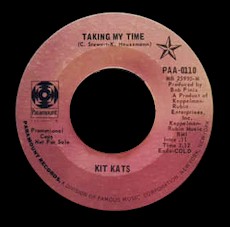 Returning
to their Kit Kats nameplate the band reappeared on Paramount for a final
non-LP single:
Returning
to their Kit Kats nameplate the band reappeared on Paramount for a final
non-LP single: